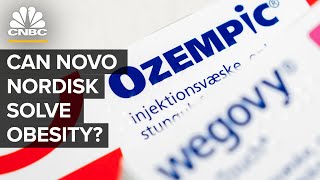
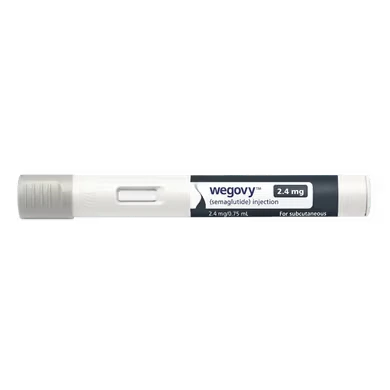

They are the same drug. Both are semaglutide, a GLP-1 analogue that the Wegovy label describes as having "94% sequence homology to human GLP-1".5 Both are made by Novo Nordisk, both come in a weekly pen, and at the same dose they do the same thing to the same receptors. Anyone who tells you one "works differently" is selling something.
What differs is the box, and the box turns out to decide almost everything practical: what a doctor can prescribe it for, what a plan will pay, how high the dose can go, and what it costs in cash. So the honest version of this comparison is short on pharmacology and long on paperwork.
What each box says it is for
Ozempic came first, in 2017, as a diabetes drug. Its approved uses are all for people with type 2 diabetes: to improve blood sugar, to cut the risk of heart attack and stroke in those with known heart disease, and to slow kidney disease.1 Weight loss is a side effect the label acknowledges and the world noticed. It is not something Ozempic is approved to be prescribed for.
Wegovy is the same molecule submitted again, in 2021, at a higher dose, for a different purpose: to reduce and maintain body weight in adults with obesity or overweight, and since 2024 also to cut cardiovascular risk in people with established heart disease and obesity.2 It is the one a plan can cover for weight, and the one a doctor can write for weight without going off-label.
The reason this matters more than it sounds: US insurers cover by indication, not by molecule. A plan that refuses "weight-loss drugs" will refuse Ozempic prescribed for weight even though it is chemically identical to a Wegovy it might cover. The box is the policy.
The dose ceilings
Both climb the same ladder from 0.25 mg, but they stop at different rungs. The Ozempic label is plain about its top: "The maximum recommended dosage is 2 mg once weekly."6 The Wegovy label keeps going, to a maintenance dose of "either 1.7 mg or 2.4 mg (recommended)" and, for some patients, "a maximum dosage of 7.2 mg subcutaneously once weekly."7 Your prescriber decides which step you are on; the labels only set the ceiling.
| Ozempic | Wegovy | |
|---|---|---|
| Starting dose | 0.25 mg | 0.25 mg |
| Standard maintenance | 0.5, 1 mg | 1.7, 2.4 mg |
| Maximum | 2 mg | 2.4 mg, or 7.2 mg HD pen |
| Daily pill | Ozempic pill: 1.5, 4, 9 mg (replaces Rybelsus) | Wegovy pill: 1.5, 4, 9, 25 mg |
The weight-loss trials that made semaglutide famous were run at 2.4 mg. Ozempic's ceiling is below that. So a person taking Ozempic for weight is, by the label, capped at a dose the weight-loss evidence was not generated at. In practice the two drugs overlap heavily through 1 mg, and the difference shows at the top of the ladder, which is where people who stall want to go. The dose ladder guide walks each step.
Wegovy also has a 7.2 mg high-dose pen above the standard ladder, which Ozempic does not. The pill gap has closed. Novo's Rybelsus page now opens with "RYBELSUS® is being replaced by Ozempic® pill", and it pairs the strengths: the Ozempic pill comes in 1.5, 4 and 9 mg, said to "work similarly to RYBELSUS® tablets 3 mg, 7 mg, 14 mg".8 So each brand has a weekly pen and a daily pill, and the label still splits them: the Ozempic pill is a diabetes product, while Novo calls the Wegovy pill "the only semaglutide tablet that's FDA-approved for weight loss in adults".4
What each costs, in cash
Novo sells both direct to cash patients through its own pharmacy, and it publishes the prices.39
| Direct from Novo, per month | Ozempic | Wegovy |
|---|---|---|
| Pen, 0.25 to 1 mg | $349 | $349 |
| Pen, 1.7 and 2.4 mg | not available | $349 |
| Pen, 2 mg | $499 | n/a (Wegovy uses 1.7 / 2.4) |
| HD pen, 7.2 mg | none | $399 |
| Daily pill | from $149 (Novo does not list each strength) | $149 (1.5 mg), $199 (4 mg), $299 (9, 25 mg) |
| New-patient intro | $199 for two fills at 0.25 / 0.5 mg, to 31 Dec 2026 | same |
The counter-intuitive one: Ozempic is more expensive than Wegovy at the top of its own ladder. Its 2 mg pen is $499 while Wegovy's 2.4 mg pen is $349. The diabetes product costs $150 a month more than the weight product for a smaller dose. If you are paying cash for semaglutide and weight is the goal, there is no price argument for Ozempic at all, and the Wegovy tablet at $149 undercuts both pens.
One catch applies to every self-pay price in that table. Novo's Ozempic page says that paying this way means "your prescription will be processed outside of your insurance, will not count toward any deductibles, and cannot be applied to any insurance maximum out-of-pocket limits."9 If you have a plan and expect to hit its deductible this year, a covered fill may end up cheaper than the cash price over twelve months.
What each costs through a plan
Here the box does its real work. For type 2 diabetes, Ozempic is one of the most widely covered drugs in the country, and the maker's card can bring it to $25 for commercially insured patients. For weight loss, the same pen is routinely denied, because the plan's formulary lists it under diabetes and the prescription does not match.
Wegovy is the drug a plan can cover for weight. Whether it does is plan-specific, and here is what eight insurers' own documents say:
Which one fits you
The lowest price, full stop
cheapest all-in program we track at $69/mo
chosen from 22 qualifying programs · full breakdown · is it legit?
Tirzepatide specifically
cheapest verified tirzepatide at $85/mo
chosen from 16 qualifying programs · full breakdown · is it legit?
A pill, not an injection
cheapest oral option at $147/mo
chosen from 4 qualifying programs · full breakdown · is it legit?
FDA-approved brand medication
cheapest branded drug we track at $208/mo, which is the only route that is FDA-approved
chosen from 2 qualifying programs · full breakdown · is it legit?
Your plan billed for you
cheapest program that will bill your insurance, from $158/mo
chosen from 4 qualifying programs · full breakdown · is it legit?
No membership fee at all
$69/mo with nothing added on top
chosen from 19 qualifying programs · full breakdown · is it legit?
The strongest review record
4.8 out of 5 across 5,340 published reviews, from $199/mo
chosen from 9 qualifying programs · full breakdown · is it legit?
Third-party certification you can check
LegitScript certified and verifiable independently, from $75/mo
chosen from 2 qualifying programs · full breakdown · is it legit?
Every row is computed from today’s verified prices. Nobody picks the winners, and no program can pay to appear here.
The pattern is consistent: Ozempic for weight loss is "no" almost everywhere, Wegovy is "depends on your plan" almost everywhere, and the exceptions are TRICARE (covers Wegovy) and Humana (covers neither). Each linked sheet quotes the insurer verbatim. If you have diabetes and want Ozempic, you are in the easy case. If you want semaglutide for weight, the coverage guide is about Wegovy, and the appeal guide is for when it is refused.
The third box: compounded semaglutide
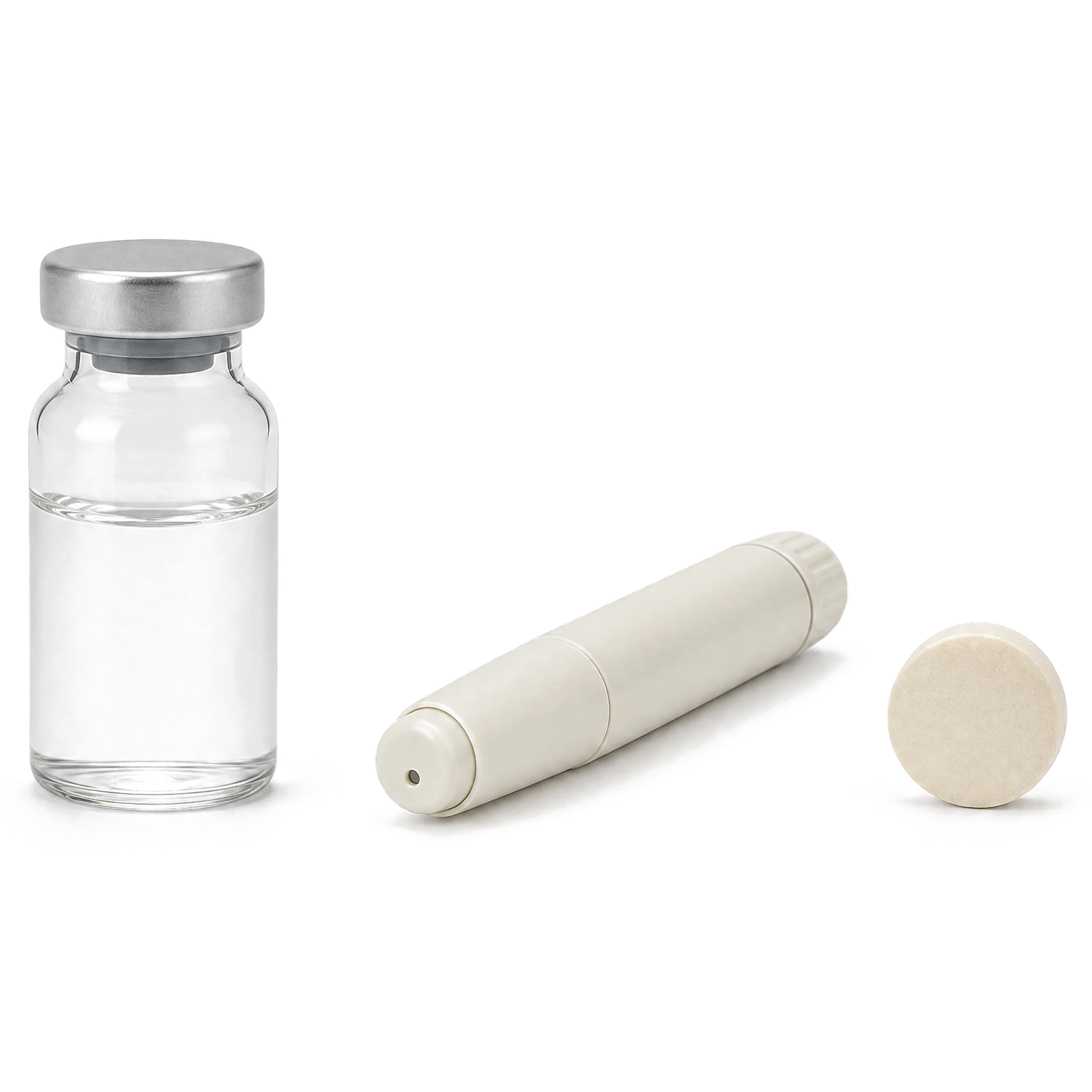
Because both brands are one molecule, the cheap route is also one molecule. Licensed compounding pharmacies sell semaglutide through telehealth programs at a fraction of Novo's price. Same active ingredient, no FDA approval of the finished product, and the pharmacy's licensing is what stands behind it. Novo's own line is blunt: "Only Novo Nordisk manufactures FDA-approved semaglutide medicines".1 Both things are true at once. Here is what the compounded route costs today, from every seller we track, verified on their own pages:
From $69 a month against $349 for either brand's pen. For a lot of people paying cash that gap, roughly $3,400 a year, is the whole decision, and it is why "Wegovy vs Ozempic" is often the wrong question: the real comparison is branded semaglutide versus compounded, and how to check the seller before you decide.
So which one
- Type 2 diabetes, insured: Ozempic. It is approved for you, widely covered, and the card takes it to $25.
- Weight loss, insured: Wegovy. It is the box a plan can cover for weight; Ozempic on a weight prescription will usually be refused.
- Weight loss, paying cash: not Ozempic. Wegovy's pen is the same price to 1 mg and cheaper above it, and the Wegovy tablet is cheaper than either pen. Below all of them is compounded semaglutide, with the trade-off stated above.
- Want the higher doses: Wegovy. 2.4 mg and 7.2 mg exist only on that box.
- Want a pill: the Wegovy pill for weight; the Ozempic pill if the reason is type 2 diabetes. Anyone on Rybelsus needs a new prescription to move to it, and Novo says it "will have the same coverage as RYBELSUS®".8
The honest summary
There is no clinical contest between Wegovy and Ozempic because there is no clinical difference at the doses they share. The contest is administrative: Ozempic is the diabetes box and Wegovy is the weight box, and the box decides your coverage, your ceiling and, at the top of the ladder, your cash price. Decide which box matches your prescription, then decide whether the brand is worth $280 a month more than the compounded version of the same molecule.