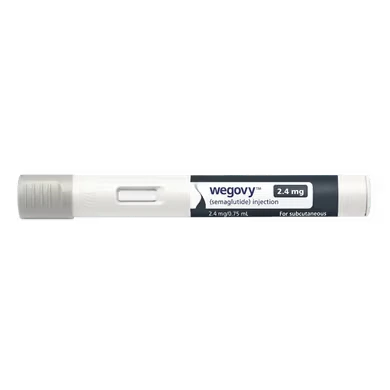


For three years this comparison ran on inference. Tirzepatide's own trials produced bigger numbers than semaglutide's own trials, and everyone drew the obvious conclusion while noting, correctly, that you cannot compare two trials with different patients. Then Lilly paid for the trial that settles it.
The head-to-head, and what it found
SURMOUNT-5 put 751 adults with obesity, none of them diabetic, on one drug or the other for 72 weeks. Not a fixed dose: each person was pushed to the highest dose they could tolerate, which for tirzepatide meant 10 or 15 mg and for semaglutide 1.7 or 2.4 mg.2 That design matters. It is a fair fight between the best each drug can do in a real body, not between two package inserts.
The result, published in the New England Journal of Medicine:1
| At week 72 | Tirzepatide | Semaglutide |
|---|---|---|
| Body weight | −20.2% | −13.7% |
| Waist circumference | −18.4 cm | −13.0 cm |
| Reached ≥10%, 15%, 20%, 25% loss | more likely on tirzepatide at every threshold | |
Among participants with obesity but without diabetes, treatment with tirzepatide was superior to treatment with semaglutide with respect to reduction in body weight and waist circumference at week 72.
Aronne et al., NEJM 2025, conclusions
One caveat the trial's own authors would insist on. It was open-label, meaning everyone knew which drug they were taking, and weight is not immune to expectation. It also excluded people with type 2 diabetes, where semaglutide has the longer record and where the gap in earlier trials was narrower. If you are diabetic this result is suggestive, not decisive.
Why one of them wins
Semaglutide imitates one gut hormone, GLP-1, which slows the stomach, blunts appetite and improves insulin response. Tirzepatide imitates two: it is, in its own label's words, "a GIP receptor and GLP-1 receptor agonist".3 GIP is the second incretin hormone, and adding it appears to do more than double up on the same effect. Exactly how the two receptors combine is still argued over in the literature, but the clinical outcome is not argued over any more. The second hormone buys the extra weight loss.
The mechanical difference also shows in how the drugs are run up. Both start low and climb every four weeks. Semaglutide's ladder tops out at 2.4 mg in five steps. Tirzepatide's climbs in six steps to 15 mg, with 2.5 mg described by Lilly as a starting dose only and not one you stay on.3 More rungs on the ladder is one reason tirzepatide can be tuned more finely to what a person tolerates.
Side effects: the same family
Both drugs cause the same things, because both slow the gut: nausea, diarrhoea, vomiting, constipation, stomach pain, tiredness. Both carry the same boxed warning about thyroid C-cell tumours from preclinical studies and the same contraindication for anyone with a personal or family history of medullary thyroid carcinoma. Both list pancreatitis and gallbladder problems as serious but uncommon.
SURMOUNT-5 did not find a new signal that separates them. The pattern across trials is that the gut effects track the dose and the pace of escalation rather than the molecule, which is why a slower climb is the standard fix for either drug. We cover what each label lists in semaglutide side effects and the Wegovy label specifically.
What each one costs, at every route
This is where the comparison usually stops and where it should start, because the better drug costs more on every route you can buy it, and the difference is not marginal.
Compounded, through a telehealth program
Compounded versions of both molecules are sold by licensed pharmacies through online programs. They are lawful, they are the same active ingredient, and they are not FDA-approved. That means the finished product has not been reviewed for safety, effectiveness or quality, and the pharmacy's own licensing carries that weight instead. With that said plainly, here is what they cost today, ranked from every seller we track and verified on each seller's own page:
Against the same for semaglutide:
The pattern holds across the whole board: at the same seller, tirzepatide is typically 50% to 100% dearer than semaglutide, and the cheapest entry points we have verified sit at $85 and $69 a month respectively. Over a year that is a difference of roughly $200, before any dose increases.
Branded, buying direct
Both manufacturers now sell to cash patients at published prices. Lilly's Zepbound climbs with your dose:4
| Zepbound self-pay (vial or KwikPen) | Per month |
|---|---|
| 2.5 mg (starting dose) | $299 |
| 5 mg | $399 |
| 7.5 mg | $499 ($449 with on-time refills) |
| 10, 12.5 and 15 mg | $699 ($449 with on-time refills) |
The $449 is Lilly's refill offer on the single-dose vial or the KwikPen at 7.5 mg and above, kept while each refill is within 45 days of the last.6
Novo's Wegovy does not climb, and it has a cheaper form:5
| Wegovy self-pay | Per month |
|---|---|
| Tablet, 1.5 mg | $149 |
| Tablet, 4 mg | $199 |
| Tablet, 9 and 25 mg | $299 |
| Pen, 0.25 to 2.4 mg | $349 ($199 for the first two fills if new, through 31 Dec 2026) |
| HD pen, 7.2 mg | $399 |
Read the dose ladders against those prices. The 20.2% result came from people pushed to 10 or 15 mg of tirzepatide, which is the $449 tier with on-time refills, $699 at the regular price. The 13.7% came from 1.7 or 2.4 mg of semaglutide, which is the flat $349 pen. So the branded cost of the trial's own result is $449 a month with on-time refills, or $699 without, against $349: up to twice the price for half again the weight loss.
Through insurance
The molecule is not what your plan cares about. It cares about the indication on the box. Zepbound and Wegovy are the weight-loss products and are the ones a plan may cover for obesity; Mounjaro and Ozempic carry the same molecules with a diabetes indication and are routinely refused for weight loss. Whether Zepbound or Wegovy is covered depends on your specific plan, and we hold the insurers' own documents for eight of them in the coverage sheets. Where both are covered, the copay cards from both makers bring either to $25 a month, and at that point the price difference between the drugs disappears and only the trial result is left.
What that leaves you deciding
The trial has done the hard part. What remains is a trade between an extra six or seven percent of body weight and somewhere between $50 and $350 a month, depending on the route.
- If you are paying cash and the budget is tight, semaglutide is where most people start, because $69 to $149 a month is a different category of commitment from $85 to $449 or $699, and 13.7% is not a small number. The board above shows the exact seller and price.
- If you have tried semaglutide and stalled, tirzepatide is the documented step up. That is what the trial measured: the same population, the better result. Switching between them has its own guide.
- If your plan covers either at $25, take tirzepatide. There is no longer a price argument for the weaker drug.
- If you have type 2 diabetes, the head-to-head does not directly cover you, and the drug your plan covers is likely the one you can actually get.
The honest summary
Tirzepatide is the better weight-loss drug, by a margin that a properly run trial has now put at 6.5 percentage points of body weight over 72 weeks. It is also the more expensive one at every route, by 50% to 100%. Neither fact cancels the other. The right choice is the one where the price you can actually pay meets the result you actually need. The numbers on this page are there so you can do that arithmetic for yourself.


