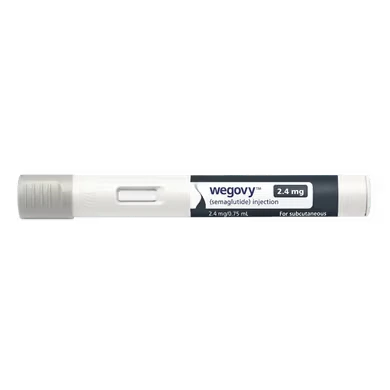


You qualify for Wegovy or Zepbound for weight loss if you are an adult with a BMI of 30 or more, or a BMI of 27 or more plus at least one weight-related condition such as high blood pressure, high cholesterol or type 2 diabetes. That is the line the FDA drew when it approved Zepbound in November 2023, and the line both drugs' trials used.1149 Wegovy's injection also covers children 12 and older with obesity.1
Weight is not the only door. Wegovy is also approved to lower the risk of heart attack, stroke and cardiovascular death in adults with established heart disease and obesity or overweight, and to treat a liver disease called MASH.2 Zepbound is also approved for moderate to severe obstructive sleep apnea in adults with obesity.8 Each of those uses has its own test, set out below.
Then the second filter: your plan. A prescription and a covered prescription are different things. Aetna's 2026 weight-loss policy asks for a BMI of 35 and six months in a weight program before it pays,15 and Medicare's GLP-1 Bridge takes BMI 30 only with one of three named conditions.26 This page walks through all three layers, label, plan and Medicare, with a BMI table by height so you can check your own number.
The lowest BMI at which an adult qualifies for Wegovy or Zepbound for weight loss, and only with a weight-related condition. Without one, the line is 30. Wegovy's MASH use has no BMI line at all.
Who qualifies, at a glance
Every approved use of the two drugs, the test it carries on the label or in its trial, and the age it covers. "BMI" is body mass index, weight against height; the formula and a full table come further down.
| Use | Drug and form | Who the label covers | The number behind it |
|---|---|---|---|
| Weight loss and keeping it off | Wegovy injection | Adults and children 12+ with obesity; adults with overweight plus a weight-related condition1 | Adults: BMI 30+, or 27 to 29.9 with a condition.4 Ages 12 to 17: BMI at the 95th percentile or above for age and sex6 |
| Weight loss and keeping it off | Wegovy tablets | Adults with obesity, or overweight plus a weight-related condition3 | Same adult numbers; not established for children3 |
| Weight loss and keeping it off | Zepbound (pen, vial or KwikPen) | Adults with obesity, or overweight plus a weight-related condition8 | BMI 30+, or 27 to under 30 with a condition;9 not established for children10 |
| Lower risk of heart attack, stroke and CV death | Wegovy injection and tablets | Adults with established CV disease and obesity or overweight2 | The trial: age 45+, BMI 27+, a prior heart attack, stroke or peripheral artery disease, no diabetes5 |
| MASH (fatty liver disease with scarring) | Wegovy injection only | Adults with noncirrhotic MASH and F2 to F3 fibrosis2 | No BMI line. The trial used a liver biopsy showing stage 2 or 3 fibrosis6 |
| Moderate to severe obstructive sleep apnea | Zepbound | Adults with obesity8 | The trials: AHI of 15 or more and BMI 30+9 |
Two practical readings of that table. If you have type 2 diabetes, you still meet the weight-loss test at BMI 27, since diabetes counts as a weight-related condition in FDA's own wording.11 And if your only route is the heart use, it belongs to Wegovy, not Zepbound: Zepbound's label carries no cardiovascular indication.8
What the FDA labels actually say
The label is the document a prescriber works from and the one every insurer copies into its policy. Here is Wegovy's injection indication for weight, in the label's words:1
WEGOVY injection is indicated in combination with a reduced calorie diet and increased physical activity ... to reduce excess body weight and maintain weight reduction long term in ... adults and pediatric patients aged 12 years and older with obesity ... adults with overweight in the presence of at least one weight-related comorbid condition
Wegovy prescribing information
The tablet's wording is the same for adults and leaves out children.3 Zepbound's reads almost word for word, with sleep apnea added as a second use:8
to reduce excess body weight and maintain weight reduction long term in adults with obesity or adults with overweight in the presence of at least one weight-related comorbid condition. ... to treat moderate to severe obstructive sleep apnea (OSA) in adults with obesity.
Zepbound prescribing information
Read them closely and you will notice what is missing: neither indication prints a BMI number. They say "obesity" and "overweight". The numbers come from two places: the trials each label describes, and the standard medical definitions of those words. The label also ties every use to diet and activity ("in combination with a reduced calorie diet and increased physical activity"), which is why plans and Medicare ask your prescriber to confirm a lifestyle program.127
Where BMI 30 and BMI 27 come from
The trials. Wegovy's Study 2, 68 weeks long, enrolled 1,961 people with a BMI of 30 or more, or 27 to 29.9 with at least one weight-related condition such as treated or untreated high cholesterol or high blood pressure.4 Zepbound's Study 1 enrolled 2,539 adults on the same two lines, naming high cholesterol, high blood pressure, sleep apnea and heart disease as example conditions.9 Both weight trials left out people with type 2 diabetes, who were studied separately.49
FDA then wrote the numbers out when it approved Zepbound on 8 November 2023: adults with obesity, "body mass index of 30 kilograms per square meter (kg/m2) or greater", or overweight, "body mass index of 27 kg/m2 or greater", with at least one weight-related condition "such as high blood pressure, type 2 diabetes or high cholesterol".11
The words line up with the CDC's adult categories: obesity is a BMI of 30.0 or higher, and severe obesity a BMI of 40.0 or higher.14 Overweight is the band below, 25.0 to 29.9, but the drugs start at 27 within it, and only with a condition.
The label's conditions are examples, not a closed list. "Such as" in the trial descriptions and in FDA's release leaves the judgment with the prescriber.411 Insurers and Medicare do close the list, which is where most denials start.
The heart, liver and sleep apnea uses, test by test
Wegovy for heart disease
FDA approved this use on 8 March 2024, for adults with cardiovascular disease and either obesity or overweight.13 The label now covers both the injection and the tablets for it.23 Who the trial took is the useful detail: everyone was 45 or older, with a BMI of 27 or more and established heart or artery disease, meaning a prior heart attack, a prior stroke or peripheral arterial disease. People with type 1 or type 2 diabetes were excluded.5
So the heart use does not need a second weight-related condition at BMI 27 to 29.9: the heart disease is the condition. It does need the history to be on paper, because every plan that covers it asks for one.
Wegovy for MASH
MASH stands for metabolic dysfunction-associated steatohepatitis, the condition once called NASH: fat in the liver with inflammation and scarring. Wegovy injection treats noncirrhotic MASH with moderate to advanced fibrosis, stages F2 to F3, in adults, under accelerated approval that depends on a confirmatory trial.2 The tablets are not approved for it.3
This is the one Wegovy use with no BMI requirement in its indication.2 The trial enrolled people by liver biopsy, showing MASH with fibrosis stage 2 or 3.6 Qualifying runs through a liver diagnosis, usually from a gastroenterologist or hepatologist, not through the scale.
Zepbound for obstructive sleep apnea
FDA approved Zepbound for moderate to severe obstructive sleep apnea in adults with obesity on 20 December 2024.12 The trials measured severity with the apnea-hypopnea index, AHI, the number of breathing pauses and shallow breaths per hour of sleep: they enrolled people with an AHI of 15 or more and a BMI of 30 or more.9 An AHI of 15 needs a sleep study, so this route starts with one.
Our Zepbound for sleep apnea guide covers the condition itself and how that use is billed.
Who should not take them
Eligibility has a floor and a ceiling. The labels name the people who should not take the drug at all, whatever their BMI:
- Thyroid cancer history. Both labels are contraindicated with a personal or family history of medullary thyroid carcinoma (MTC) or in people with Multiple Endocrine Neoplasia syndrome type 2 (MEN 2).710
- A known allergy to semaglutide or tirzepatide, or to an ingredient of the product.710
- Pregnancy. Both labels say to stop when pregnancy is recognized, for the weight and heart uses of Wegovy and for Zepbound.710
- Children, for Zepbound and the Wegovy tablet. Zepbound's safety and effectiveness are not established in pediatric patients; neither are the Wegovy tablets'.103
Every prescriber, in person or online, asks about these. They are why an intake form wants your family history as well as your weight. Your prescriber decides the rest from your full history; nothing on this page is a substitute for that conversation.
What counts as a weight-related condition
The phrase does most of the work at BMI 27 to 29.9, and the sources name different examples. Lined up:
| Source | Conditions it names | Closed list? |
|---|---|---|
| Wegovy weight trials (label) | Treated or untreated high cholesterol (dyslipidemia) or high blood pressure, "such as"4 | No |
| Zepbound weight trial (label) | High cholesterol, high blood pressure, obstructive sleep apnea, heart disease, "such as"9 | No |
| FDA Zepbound approval, 2023 | High blood pressure, type 2 diabetes, high cholesterol, "such as"11 | No |
| Medicare GLP-1 Bridge, BMI 30 to 34.9 | Heart failure with preserved ejection fraction; uncontrolled high blood pressure; chronic kidney disease stage 3a or higher26 | Yes |
| Medicare GLP-1 Bridge, BMI 27 to 29.9 | Prediabetes; a previous heart attack or stroke; peripheral artery disease with symptoms26 | Yes |
Notice the gap between the rows. High cholesterol qualifies on the label and does not appear anywhere in Medicare's list. High blood pressure qualifies on the label at 27; Medicare accepts it only when uncontrolled and only from BMI 30.26 If you are on Medicare, the label's examples are not your test.
BMI for Wegovy and Zepbound: the table by height
The formula, in US units: BMI = weight in pounds × 703 ÷ (height in inches × height in inches). In metric, weight in kilograms divided by height in meters squared. Reverse it to find the weight that reaches a given BMI at your height: weight = BMI × height in inches × height in inches ÷ 703.
We ran that for every inch from 4 ft 10 in to 6 ft 6 in at the four lines that matter: 27 (with a condition), 30 (on its own), 35 (Aetna's and BCBS Michigan's weight policies, and Medicare's no-condition tier) and 40 (the CDC's severe obesity line).14152126 Each figure is rounded up to the next whole pound, so it is the lowest weight that actually reaches the line.
| Height | Inches | BMI 27 | BMI 30 | BMI 35 | BMI 40 |
|---|---|---|---|---|---|
| 4 ft 10 in | 58 | 130 lb | 144 lb | 168 lb | 192 lb |
| 4 ft 11 in | 59 | 134 lb | 149 lb | 174 lb | 199 lb |
| 5 ft 0 in | 60 | 139 lb | 154 lb | 180 lb | 205 lb |
| 5 ft 1 in | 61 | 143 lb | 159 lb | 186 lb | 212 lb |
| 5 ft 2 in | 62 | 148 lb | 165 lb | 192 lb | 219 lb |
| 5 ft 3 in | 63 | 153 lb | 170 lb | 198 lb | 226 lb |
| 5 ft 4 in | 64 | 158 lb | 175 lb | 204 lb | 234 lb |
| 5 ft 5 in | 65 | 163 lb | 181 lb | 211 lb | 241 lb |
| 5 ft 6 in | 66 | 168 lb | 186 lb | 217 lb | 248 lb |
| 5 ft 7 in | 67 | 173 lb | 192 lb | 224 lb | 256 lb |
| 5 ft 8 in | 68 | 178 lb | 198 lb | 231 lb | 264 lb |
| 5 ft 9 in | 69 | 183 lb | 204 lb | 238 lb | 271 lb |
| 5 ft 10 in | 70 | 189 lb | 210 lb | 244 lb | 279 lb |
| 5 ft 11 in | 71 | 194 lb | 216 lb | 251 lb | 287 lb |
| 6 ft 0 in | 72 | 200 lb | 222 lb | 259 lb | 295 lb |
| 6 ft 1 in | 73 | 205 lb | 228 lb | 266 lb | 304 lb |
| 6 ft 2 in | 74 | 211 lb | 234 lb | 273 lb | 312 lb |
| 6 ft 3 in | 75 | 216 lb | 241 lb | 281 lb | 321 lb |
| 6 ft 4 in | 76 | 222 lb | 247 lb | 288 lb | 329 lb |
| 6 ft 5 in | 77 | 228 lb | 253 lb | 295 lb | 338 lb |
| 6 ft 6 in | 78 | 234 lb | 260 lb | 303 lb | 347 lb |
Why round up matters. At 5 ft 5 in and 180 lb, the formula gives 29.95. That is not 30. A policy written as "BMI greater than or equal to 30" reads 29.95 as below the line, and a form that rounds to one decimal shows 30.0 while the math says otherwise. If you sit within a pound or two of a line, ask your prescriber to record the exact figure from a measured height and weight on the day, not a remembered one.
The BMI and GLP-1 calculator does this for any height and weight and tells you which tier you land in.
How insurers narrow the label
A plan can cover a drug for fewer people than the label allows, and most do. Three things move, in roughly this order of frequency: whether the plan covers weight-loss drugs at all, the BMI line, and the extra steps before and after approval.
Coverage at all is the employer's choice. Aetna tells employers they can "customize your benefits to include or exclude GLP-1 drug coverage for weight management".20 KFF's 2025 survey found 16% of firms with 200 to 999 workers, 30% of firms with 1,000 to 4,999 and 43% of firms with 5,000 or more cover GLP-1s used mainly for weight loss.24 Our employer coverage guide has the full picture of who covers and who dropped it.
The BMI line often moves to 35. Aetna's 2026 policy for its BMI 35 design reads:15
The patient is 18 years of age or older. The patient has participated in a comprehensive weight management program that encourages behavioral modification, reduced-calorie diet, AND increased physical activity with continuing follow-up for at least 6 months prior to using drug therapy. The patient has a baseline body mass index (BMI) greater than or equal to 35 kg/m 2 .
Aetna policy 6450-C
Blue Cross Blue Shield of Michigan set the same line for its large group, fully insured members: 18 or older with a BMI of 35 or higher.21 Notice what a BMI 35 policy drops: the weight-related condition. At 35 you need no condition; below it, on these designs, no condition gets you in for weight loss.
The extra steps. A documented weight program is the most common add-on. Aetna wants six months of it before drug therapy,15 and KFF found 34% of employers that cover these drugs require a dietitian, case manager, therapist or lifestyle program.24 Renewal is the second: Aetna's continuation test for Wegovy, Zepbound and Foundayo is at least 3 months at a stable maintenance dose and at least 5% of baseline weight lost, or that 5% kept off.16
| Plan or program | BMI line for weight loss | Before approval | To renew |
|---|---|---|---|
| FDA label (no plan) | 30, or 27 with a condition11 | A prescription | n/a |
| Aetna, BMI 35 design (6450-C, 2026) | 35, adults 18+15 | 6 months in a weight program, documented15 | 3 months at a stable dose and 5% weight loss, or 5% kept off16 |
| BCBS Michigan and BCN, large group fully insured | 35, adults 18+21 | Prior authorization21 | Not published on the page we read |
| FEP Blue (federal employees) | Policy-specific | An excluded drug needs a formulary exception from your prescriber22 | Policy-specific |
| TRICARE Prime, Select and premium plans | TRICARE's own clinical criteria23 | A network prescriber and a prior authorization23 | Not on the FAQ |
| TRICARE For Life | Not covered for weight loss23 | n/a | n/a |
| Medicare GLP-1 Bridge | 35; or 30 or 27 with named conditions26 | Prescriber certifies a lifestyle program; prior authorization27 | See our Medicare guide |
The formulary matters too, not only the criteria. CVS Caremark, which runs pharmacy benefits for many employer plans, said it would add Zepbound back to its commercial formularies as a preferred option on 1 October 2026, for plan sponsors that cover these drugs.25 If your plan uses Caremark and denied Zepbound earlier in 2026, the answer may be different now.
For the plan you actually have, our coverage checker holds sourced fact sheets per insurer and drug, including Aetna and Wegovy, Cigna and Wegovy and UnitedHealthcare and Zepbound, each with the policy's own words.
What plans ask for on the heart, liver and sleep apnea uses
These uses are where a plan that excludes weight-loss drugs may still pay, because the drug is treating something else. They are also where the paperwork is most specific. Aetna's 2026 policy is the clearest published example we found, and each criterion below needs documentation for approval:
- Wegovy for heart risk. A history of a previous heart attack, a previous stroke, symptomatic peripheral artery disease (with test or procedure evidence such as an ankle-brachial index below 0.85), or a prior revascularization such as a bypass or stent. A baseline BMI of 27 or more. No type 2 diabetes. And current standard heart treatment, or a clinical reason not to have it.18
- Wegovy for MASH. Prescribed by or with a gastroenterologist or hepatologist, with F2 to F3 fibrosis confirmed by elastography (ultrasound or MRI) or a past liver biopsy.19
- Zepbound for sleep apnea. An established diagnosis of moderate to severe obstructive sleep apnea with an AHI of at least 15 events per hour on an in-lab sleep study or a home sleep test, and a current BMI of 30 or more.17
The type 2 diabetes exclusion on the heart route is the one that surprises people. Aetna's note points patients with type 2 diabetes and heart disease to Ozempic, which carries its own cardiovascular indication for that group, rather than Wegovy.18 The heart trial itself excluded diabetes, which is where that line comes from.5
If a plan turns you down on any route, the denial letter names the criterion you missed. Our appeal guide covers what to send back, and a Wegovy prior authorization letter or Zepbound prior authorization letter template gives your prescriber the structure plans expect.
Medicare: who qualifies for the GLP-1 Bridge
Medicare drug plans cannot pay for drugs used only for weight loss; Part D may cover Wegovy when it is prescribed for cardiovascular disease.29 The Medicare GLP-1 Bridge is the separate CMS program that opened weight-loss coverage on 1 July 2026, with a $50 copay outside the Part D benefit.28 Its eligibility test is stricter than the label in one direction and looser in another:
| Your BMI when you start GLP-1 therapy | Plus at least one of | Compared with the label |
|---|---|---|
| 35 or higher | Nothing else26 | Same as label: any BMI over 30 qualifies there |
| 30 to 34.9 | Heart failure with preserved ejection fraction; uncontrolled high blood pressure; chronic kidney disease stage 3a or higher26 | Stricter: the label needs no condition at 30 |
| 27 to 29.9 | Prediabetes; a previous heart attack or stroke; peripheral artery disease with symptoms26 | Narrower list than the label's examples |
You must be 18 or older, and your prescriber must certify that you are using the drug as part of a lifestyle program focused on diet and exercise.2627 Medicare.gov rules out anyone who already gets a GLP-1 covered through their Part D plan, and people with type 2 diabetes, moderate to severe sleep apnea or fatty liver disease, whose Part D plan may cover a GLP-1 for that condition instead.27 One detail from Novo saves a question at the appointment: your doctor does not need to be enrolled in Medicare for you to use the Bridge.30
Run your own numbers through the Medicare Bridge eligibility check, and read does Medicare cover GLP-1s for the drug-by-drug routes, the copay rules and what happens after 2027.
Already on a GLP-1? Your starting BMI is the one that counts
People who lose weight on a cash-pay GLP-1 often worry they have priced themselves out of coverage. The published rules point the other way. Medicare's tiers apply to your BMI "when you start GLP-1 therapy".26 Aetna's policy tells reviewers that if a patient is moving from another weight-loss drug, they should "consider their baseline BMI at the start of any drug therapy".15
The practical step: keep the record of your weight on the day you first started, with the date and who measured it. A pharmacy receipt with no weight on it does not help; a visit note or intake record that does is what a reviewer asks for.
What a telehealth intake asks
An online prescriber applies the same label as an office doctor. NovoCare, Novo Nordisk's own pharmacy, links people without a prescription to telehealth prescribers from its home page,31 and the telehealth programs on our board run their own intake the same way. Expect the questions to follow the label, in roughly this order:
- Height and current weight, which set your BMI. Have a recent measured figure ready rather than a guess.
- Weight-related conditions, if your BMI is 27 to 29.9: blood pressure, cholesterol, blood sugar, sleep apnea, heart disease.49
- The contraindications: thyroid cancer history in you or your family, MEN 2, allergies, pregnancy or plans for it.710
- Other GLP-1 medicines, including compounded versions, because both labels advise against combining GLP-1 drugs.38
- Your medical history and current medicines, which help if a plan later asks for documentation.
The prescription is one question; paying for it is another, and the price differs widely between routes. Novo's own self-pay prices for Wegovy are $349 a month for the standard pen doses and $149 to $299 for the tablet by strength.31 The programs we track list all-in monthly prices, membership included, ranked here:
Live chart · checked 15 Oct 2026
Every Wegovy price we track, all in
3 programs, cheapest first: the monthly price plus any membership fee, read off each seller's own page. The full ranking
If you qualify for Zepbound rather than Wegovy, the cheapest verified Zepbound price today is $348 a month, and the live ranking sits below. For the steps from qualifying to a filled prescription, see how to get Wegovy and how to get Zepbound.
Which route fits you
Match your situation to the route that is most likely to say yes. Each row assumes the label test is met; the third column is the extra test that route adds.
| Your situation | Route most likely to cover it | What that route adds |
|---|---|---|
| BMI 35+, commercial plan that covers weight-loss drugs | Your plan, weight-loss criteria | Often a documented weight program (Aetna: 6 months) and a 5% renewal test1516 |
| BMI 30 to 34.9, commercial plan | Your plan, if its design uses the label line | A BMI 35 design will refuse; ask which design your employer bought1521 |
| BMI 27 to 29.9 with high blood pressure or cholesterol | A plan that follows the label | The condition documented on the request |
| Prior heart attack, stroke or peripheral artery disease, BMI 27+, no diabetes | Your plan, under Wegovy's heart use; on Medicare, Part D229 | The cardiac history on file and current heart treatment18 |
| Diagnosed MASH with F2 to F3 fibrosis | Your plan, under Wegovy's liver use | A liver specialist and elastography or biopsy19 |
| Moderate to severe sleep apnea, BMI 30+ | Your plan, under Zepbound's sleep apnea use | A sleep study showing AHI 15+17 |
| Medicare with Part D, no diabetes, in a Bridge tier | Medicare GLP-1 Bridge, $50 a month27 | Prescriber certifies a lifestyle program2728 |
| TRICARE For Life | Medicare Part D or the Bridge, not TRICARE23 | Bridge tiers apply |
| Plan excludes weight-loss drugs, no other covered use | Self-pay from the maker, or a program on our board | The label test only, set by the prescriber |
What to bring to the appointment
Eligibility is decided on documents, so bring them. This list is short on purpose: each item answers a question a label, a plan or Medicare will ask.
- Your measured height and weight, and if you are already on a GLP-1, the record of your weight when you started.1526
- Diagnoses with dates: blood pressure readings, cholesterol results, an A1C or prediabetes result, sleep study results with the AHI, heart history, liver imaging.
- Your plan's drug list and the policy name, if you have coverage. Search your insurer's site for the drug name plus "prior authorization".
- Proof of a weight program, if your plan asks for one: dates, the program name, visits with a dietitian or coach.1524
- Family history of thyroid cancer or MEN 2, which every prescriber screens for.710
With those in hand, the first question, do I qualify, usually takes one visit. The second, will it be paid for, is answered by the route table above.