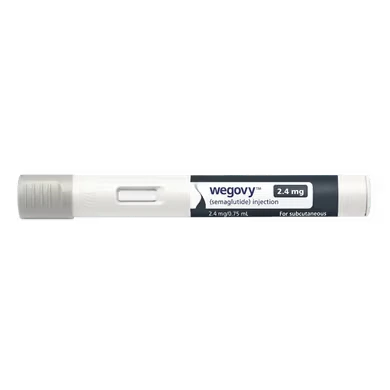


Usually yes, for the drug itself. The IRS counts "prescribed medicines and drugs" as medical expenses, and a GLP-1 is sold only on a prescription.1 Money in an HSA, a health FSA or an HRA can pay for medical expenses tax free, so the medication normally qualifies. The fees around the drug are where the answer turns, and your plan administrator, not this page and not the seller, decides each claim.
We track prices, not tax rules. Everything below is the IRS's own wording with a link and the date we read it. Before you pay, check with your plan administrator (the company named on your HSA or FSA card) how it treats your purchase.
The two IRS sentences that decide it
Almost every answer on this topic comes back to two passages in IRS Publication 502, the document that defines medical expenses for HSAs, FSAs and the itemized deduction alike.
The first is about drugs. Read it closely, because the test is the prescription:
You can include in medical expenses amounts you pay for prescribed medicines and drugs. A prescribed drug is one that requires a prescription by a doctor for its use by an individual.
IRS Publication 502, Medicines
Every GLP-1 program we track sells only on a prescription, so the drug clears that sentence on its face.1 The same section closes the door on anything bought without one: "Except for insulin, you can't include in medical expenses amounts you pay for a drug that isn't prescribed."
The second passage is about weight-loss programs, and it carries a condition the drug sentence does not:
You can include in medical expenses amounts you pay to lose weight if it is a treatment for a specific disease diagnosed by a physician (such as obesity, hypertension, or heart disease).
IRS Publication 502, Weight-Loss Program
That sentence covers "fees you pay for membership in a weight reduction group" too.2 Its mirror image, in the list of what is not includible, is blunt: a program whose purpose is "the improvement of appearance, general health, or sense of well-being" does not count, and neither do its membership fees.3 The IRS repeats the rule in its FAQ on wellness costs: a weight-loss program qualifies "only if the program treats a specific disease diagnosed by a physician (such as obesity, diabetes, hypertension, or heart disease)."6
Put together: the drug is judged on the prescription, and the program around it is judged on the diagnosis. Behind both sits the general definition, which says medical expenses are the costs of "diagnosis, cure, mitigation, treatment, or prevention of disease".4
Is Wegovy HSA eligible? Is Zepbound FSA eligible?
By the IRS text, a prescribed Wegovy, Zepbound, Ozempic, Mounjaro or Foundayo fill is a prescribed drug, and the brand makes no difference to that sentence.1 What the makers say is about payment, not tax status:
- NovoCare Pharmacy (Wegovy, Ozempic): "We accept credit cards, Apple Pay, Google Pay, and FSA/HSA cards," and, asked directly whether FSA/HSA funds work, "Yes, we accept payment from FSA/HSA funds."18
- LillyDirect (Zepbound, Mounjaro, Foundayo): it "accepts most major insurance plans, FSA/HSA cards, and all major credit cards through our dispensing pharmacies."20
- Lilly's Zepbound savings page marks its offers "HSA / FSA eligible" and adds the line that matters: "FSA/HSA eligibility may vary by plan. Check with your benefits administrator to confirm eligibility."21
A card that goes through at checkout is not the same as a claim your administrator accepts. Card acceptance means the pharmacy can take the payment; whether the expense qualifies is still the IRS test, applied by your plan.
If you are paying the makers directly, our guides on Zepbound's cost without insurance and every route to a GLP-1 without insurance set out the self-pay prices by dose.
Can I use an HSA for compounded semaglutide or tirzepatide?
This is the question the ranking pages skip, so here is exactly what the sources say and no more.
The IRS medicines sentence asks one thing of a drug: does it require a prescription by a doctor for its use by an individual?1 It does not mention FDA approval. A compounded GLP-1 from a state-licensed pharmacy is, in FDA's own description of the rules, "compounded for an individual patient based on receipt of a prescription."17 FDA is equally clear that "Compounded drugs are not approved by FDA."17
So the prescription test reads the same for a compounded vial as for a branded pen. Two exclusions in Publication 502 do bite in this market, and both are about where the product came from rather than what it is:
- No prescription, no medical expense. A "research" peptide or any GLP-1 product sold without a prescription fails the first sentence outright.1
- Imported is out. "In general, you can't include in your medical expenses the cost of a prescribed drug brought in (or ordered and shipped) from another country."5
Administrators set their own review practices, and some ask for more paperwork on compounded claims. Ask yours before you prepay a long plan. Several programs on our board say they take HSA and FSA payment, listed further down.
What counts: drug, consult, membership, labs
The cost of a GLP-1 program usually splits into four or five lines, and the IRS text treats them differently. Most of the cash programs we track bundle the clinician, the drug and shipping into one all-in monthly price with no separate membership fee, which makes the receipt simpler. A few charge a membership on top: Sesame Care, for example, lists a $59 monthly membership alongside the drug.
| Cost | What the IRS text says | Source |
|---|---|---|
| Prescribed GLP-1, branded | Includible as a prescribed drug | Pub 5021 |
| Prescribed GLP-1, compounded | Same prescription test; FDA approval not mentioned | Pub 502, FDA117 |
| Clinician or telehealth visit fee | Includible: "payments for legal medical services rendered by physicians" | Pub 5024 |
| Lab work ordered by a physician | Includible: "diagnostic tests by a physician" | Pub 5024 |
| Weight-loss program or membership fee | Only when the weight loss treats a disease a physician diagnosed, such as obesity | Pub 502, IRS FAQ26 |
| Program for appearance or general health | Not includible, fees included | Pub 5023 |
| Gym membership | Not includible as general health, outside narrow exceptions | IRS FAQ6 |
| Diet food, shakes, meal plans | Not includible: they replace normal food | Pub 5023 |
| Supplements and vitamins | Only if a medical practitioner recommends them to treat a diagnosed condition | IRS FAQ6 |
| Over-the-counter medicines | Payable from an HSA, FSA or HRA (not deductible) | IRS FAQ6 |
| GLP-1 bought without a prescription | Not includible | Pub 5021 |
| Prescribed drug shipped from abroad | Generally not includible | Pub 5025 |
The membership line is the one to plan around. If your program charges a fee separate from the drug, ask for an itemized receipt that shows the two apart, so your administrator can approve the drug even if it queries the fee.
Letter of Medical Necessity, receipts and substantiation
The IRS does not use the phrase "Letter of Medical Necessity" in its drug rules. Administrators do. HealthEquity, an HSA and FSA administrator, tells FSA members they "will usually need to submit documentation to your plan administrator," which "may include a receipt, prescription, or Letter of Medical Necessity (LMN)."22 An LMN is a short note from your prescriber naming the diagnosis the treatment is for, which is the fact the weight-loss rule turns on.2
The rules on paperwork differ by account, and they come straight from Publication 969.
FSA. Before it pays, the FSA must get "a written statement from an independent third party stating that the medical expense has been incurred and the amount of the expense," plus your statement that no other plan has paid it.11 In practice that third-party statement is the pharmacy or program receipt.
HSA. Nobody checks at the time. You must keep records showing that each withdrawal paid a qualified medical expense, that the expense was not paid from another source, and that you did not also deduct it. "Don't send these records with your tax return. Keep them with your tax records."9
A practical file for each fill: the itemized receipt, the prescription or pharmacy label, and, if your program fee is in the claim, the prescriber's note naming the diagnosis. Several sellers will send these on request. Direct Meds says that "Once approved, we can provide receipts and documentation for reimbursement, if needed,"25 and Sesame Care says it "will provide an itemized bill that you can submit to your HSA or FSA."27
HSA vs FSA vs HRA for a GLP-1
All three pay for the same list of medical expenses. They differ on who funds them, what happens to unspent money, and the paperwork.
| HSA | Health FSA | HRA | |
|---|---|---|---|
| Who can have one | People covered by a high-deductible health plan, not on Medicare7 | Employees whose employer offers one | Employees whose employer offers one |
| Who puts money in | You, your employer or both | You by salary reduction; your employer may add | Your employer only13 |
| 2026 limit | $4,400 self-only, $8,750 family, plus $1,000 at 55 or older10 | $3,400 of salary reduction15 | Set by the employer |
| Unspent money | Stays yours, year to year8 | Use it or lose it, unless the plan offers a grace period (up to 2.5 months) or a carryover (up to $680 into 2026 plan years)1215 | Set by the plan |
| Paperwork | Keep your own records9 | Third-party receipt before payment11 | Set by the plan |
| Wrong-use penalty | Income tax plus a possible 20% additional tax8 | Claim is refused | Claim is refused |
Two details matter more for GLP-1 buyers than for most medical spending, because the spending is steady and long.
An FSA gives you the whole year's election on day one. Publication 969 says you "must be able to receive the maximum amount of reimbursement (the amount you have elected to contribute for the year) at any time during the coverage period, regardless of the amount you have actually contributed."11 For a monthly drug bill that front-loading helps.
But an FSA pays only for care incurred in its plan year. The same section says distributions reimburse expenses "you incurred during the period of coverage" and that "The FSA can't make advance reimbursements of future or projected expenses."11 If you prepay a 12-month compounded plan in, say, September, the months that fall in next year's plan may not be reimbursable from this year's balance. Ask your administrator how it dates a prepaid plan before you choose the long term for the discount.
An HSA has no such clock. It reimburses qualified expenses you incur after you open the account, and "You don't have to make withdrawals from your HSA each year."8 The account must exist first: a fill bought before you opened the HSA is not a qualified HSA expense.
If you have none of these accounts, Publication 502 still lets you deduct medical expenses above 7.5% of adjusted gross income if you itemize.4 You cannot do both for the same dollar: anything paid from an HSA, FSA or HRA cannot also be deducted.6
How much does paying with an HSA or FSA save?
Money that goes into an HSA or FSA through payroll skips federal income tax and, under Publication 969, employment taxes too.13 So the saving is your tax rate times what you spend. Here is the arithmetic with an example rate, stated so you can swap in your own.
The example rate: 29.65%. Start with the 22% federal bracket, which in 2026 applies to a single filer's taxable income over $50,400.15 Add the employee's 7.65% share of payroll tax: 6.2% for Social Security and 1.45% for Medicare.16 Your own rate depends on your bracket and your state, and on whether the money goes in through payroll: an HSA contribution you make outside payroll gets the income-tax deduction but not the payroll-tax saving.13
Example 1: compounded semaglutide at the board floor. The lowest all-in price on our board is $69 a month, so a year is $828. At 29.65%, paying with pre-tax money saves $245.50, and the year costs you the equivalent of $582.50 in take-home pay. At 22% alone, the saving is $182.16.
Example 2: compounded tirzepatide at the board floor. $119 a month is $1,428 a year. At 29.65% the tax saved is $423.40, for an effective cost of $1,004.60.
Example 3: the Wegovy pen bought direct. Novo charges patients new to its pharmacy $199 a month for the first two fills (an offer that runs through December 31, 2026), then $349 a month, and it defines a month as one box of four weekly pens. So 52 weeks is 13 boxes, and a first year is 2 × $199 plus 11 × $349, or $4,237.19 At 29.65% the tax saved on that spending is $1,256.27, for an effective cost of $2,980.73.
The example rate used above: 22% federal income tax plus 7.65% employee payroll tax. A higher bracket or a state income tax raises the saving; contributing to an HSA outside payroll lowers it.
Two limits shape these numbers. A $4,237 year is under the 2026 HSA self-only limit of $4,400 but over the $3,400 FSA limit, so an FSA alone cannot carry a full first year at that price.1015 And the saving is only as large as what you put in: money you spend from a checking account and never route through the account saves nothing.
The prices in examples 1 and 2 are live and move with the board. The full ranking, with each program's all-in monthly price, is on the cheapest GLP-1 page:
Programs on our board that take HSA or FSA payment
These programs say, on their own pages, that they accept HSA or FSA payment or that their treatment is eligible. We read each page on the date shown in the sources. Listed alphabetically; the board above ranks them by price.
| Program | What it says | All-in entry price on our board |
|---|---|---|
| bmiMD | "Yes, bmiMD accepts FSA and HSA payment options."26 | $119/mo on a 12-month plan |
| Direct Meds | Accepts HSA and FSA "for all GLP-1 treatments" and provides receipts on request25 | $249/mo |
| Gala Health | "FSA & HSA accepted"28 | $179/mo |
| Sesame Care | "most of the services within your subscription may be eligible"; itemized bill on request27 | $208/mo for the Wegovy pen with membership |
| Trimi | Accepts HSA and FSA payment, "but check with your plan administrator to confirm that your purchase qualifies"24 | $99/mo on a 12-month plan |
| Wellorithm | "HSA/FSA eligible"29 | $147/mo |
A program not on this list may still take your card; these are the ones that say so in writing. And a seller's "eligible" badge is a statement about its checkout, not a ruling from your plan, which is why Trimi's own wording sends you back to your administrator.24
State taxes and other edge cases
California. The federal saving applies everywhere, but not every state follows it. California's Franchise Tax Board says plainly: "California does not conform to federal legislation that enacted HSAs beginning January 1, 2004."23 For a California resident the HSA saving is federal only, so use a lower rate than the 29.65% example. If you live elsewhere, your state tax agency or your administrator can tell you how your state treats HSA contributions.
Medicare. "Beginning with the first month you are enrolled in Medicare, your contribution limit is zero."7 Medicare's own GLP-1 rules are a separate route, set out in our Medicare guide.
Telehealth. A 2025 law lets a high-deductible plan cover telehealth before the deductible without losing its HSA status.14 That is about your health plan's design; it does not change whether a cash-pay GLP-1 program qualifies, which is still the Publication 502 test.
Wrong claims. An HSA withdrawal that did not pay a qualified expense is taxed as income and "may be subject to an additional 20% tax."8 If you are unsure whether a fee qualifies, the cheaper mistake is paying it from ordinary money and asking your administrator first.
If your administrator refuses a GLP-1 claim
Ask which rule the claim failed, in writing. The IRS text above points to three usual gaps, and each has a plain fix.
- No diagnosis on file for a program fee. The weight-loss rule needs "a specific disease diagnosed by a physician."2 A prescriber's note naming the diagnosis answers it.
- A receipt that proves too little. An FSA needs a third-party statement that shows the expense was incurred and its amount.11 A card-statement line shows neither the drug nor the date of service; an itemized pharmacy receipt shows both.
- A date outside the plan year. FSA money covers expenses incurred during the period of coverage, so a fill shipped after the plan year ends belongs to the next one.11
If the drug is approved and only the fee is refused, the simple route is to pay the fee from ordinary money and keep the drug on the account. Resubmit with the missing document rather than arguing the rule: administrators apply the IRS wording, and the documents are what show it is met.
A five-step checklist before you pay
- Confirm the account. Know whether you hold an HSA, a health FSA or an HRA, and read the eligible-expense list your plan publishes.
- Ask the administrator two questions. Does it reimburse a prescribed GLP-1, including compounded? Does it need an LMN for the drug or for program fees?
- Get the diagnosis in writing. If any program fee is in the claim, the IRS test is a disease a physician diagnosed, such as obesity.2 Ask your prescriber for a short note.
- Ask the seller for an itemized receipt. Drug, visit and any membership on separate lines, with dates of service.
- Match the plan term to the account. On an FSA, a prepaid 12-month plan can straddle two plan years.11 On an HSA, keep each receipt with your tax records.9
For the prices themselves, start with the cheapest GLP-1 programs we track, and if you are deciding between paying a maker directly and a compounded program, our guide to GLP-1s without insurance lays out each route.