




GLP-1 TV · News & media
Tirzepatide or Retatrutide? Analyzing the Newest Clinical Data
Today’s cheapest GLP-1$39/mo at Wellmedr, sale price.Compare all GLP-1 prices Price read 22 Nov 2026 from the seller’s own page, ranked by price alone. That price is a compounded drug, and compounded drugs are not FDA-approved. Not from the video’s creator.Our summary
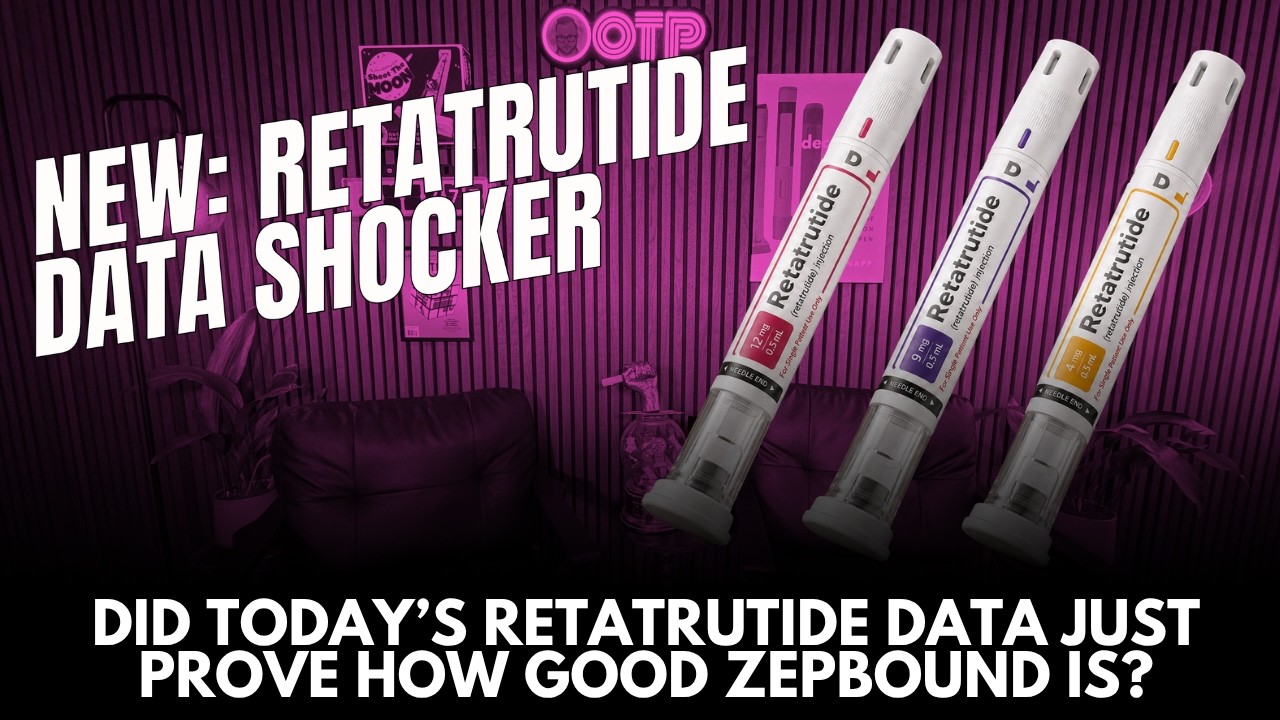
The host of On The Pen GLP-1 News reacts to Eli Lilly's new phase three top-line data for retatrutide from the Triumph 1 study. He reports that at 80 weeks, the 4 mg dose produced about 19% weight loss, the 9 mg dose about 26%, and the 12 mg dose about 28 to 29%, with roughly 45% of patients on 12 mg losing more than 30% of body weight. He says these are the figures Lilly wanted in headlines.
Published by On The Pen™ GLP-1 News on YouTube
As published by the channel. Not medical advice, and not an endorsement.
What else the video covers
He argues the numbers look different under an intention-to-treat style comparison, crediting an analyst on X. In that framing, he says, 12 mg retatrutide may deliver only about 3.3% more weight loss than tirzepatide 15 mg, and the efficacy figures of 26.4% at 9 mg and 28.7% at 12 mg fall to roughly 20% and 23% to 24%. He also describes higher GI side effects at the top doses, including nausea of about 38% to 43%, diarrhea of 33% to 35%, and vomiting approaching 20%. He notes the 4 mg arm had a 4.1% dropout rate.
The second half is his own speculation about Lilly's strategy. He suggests tirzepatide could stay the mainstream option through Lilly Direct, hopefully around $250, while retatrutide sits above it as a premium tier, possibly as a biologic with 12 years of exclusivity instead of five. He says this could mean higher prices, biosimilar rather than generic competition, and no legal compounding. He stresses that this part is opinion and asks viewers whether retatrutide looks like a replacement for tirzepatide.
Our summary of what is said, in our words. Doses, results and prices are the speaker’s, not advice.
Takeaways
The main points, in the order they come up. Tap a time to play from there.
- 2:00 The host says Lilly's Triumph 1 top-line data showed about 19% weight loss at 4 mg, 26% at 9 mg and 28 to 29% at 12 mg of retatrutide at 80 weeks.
- 4:07 He says an intention-to-treat style comparison puts 12 mg retatrutide only about 3.3% above tirzepatide 15 mg in the real world.
- 5:42 He reports higher GI side effects at the top doses, with nausea of roughly 38% to 43% and vomiting approaching 20%.
- 9:57 He notes the 4 mg arm lost about 19% with a 4.1% dropout rate, and says people with higher BMI responded for longer.
- 11:49 He speculates that tirzepatide becomes Lilly's mainstream direct-to-consumer drug, around $250, with retatrutide as a premium tier above it.
- 13:33 He explains that biologic classification would mean 12 years of exclusivity instead of five, biosimilar competition and no legal compounding.
Key moments
Tap one to play from there.
What the video says
As stated in the video, not checked by us. Doses and results are the speaker’s, not advice.
- Medication
- Zepbound, tirzepatide and retatrutide
- Side effects mentioned
- nausea, vomiting, constipation, diarrhea and bloating
Questions this video answers
How much weight did people lose on retatrutide in the Triumph 1 trial?
According to the video, Lilly's top-line data at 80 weeks showed about 19% weight loss at 4 mg, around 26% at 9 mg and about 28 to 29% at 12 mg once weekly. The host says about 45% of patients on 12 mg lost more than 30% of their body weight.
Is retatrutide much better than tirzepatide in real-world weight loss?
The host says an intention-to-treat style analysis, credited to an analyst on X, suggests 12 mg retatrutide may give only about 3.3% more weight loss than tirzepatide 15 mg. He says dropouts and discontinuations narrow the gap, though he still expects retatrutide to outperform tirzepatide.
What side effects were reported with higher-dose retatrutide?
The host reports nausea of roughly 38% to 43%, diarrhea of 33% to 35% and vomiting approaching 20% at the higher doses. He also says constipation was notably higher and that vomiting may be about double the rate seen with tirzepatide at comparable efficacy.
Could retatrutide be classified as a biologic and what would that change?
The host says a biologic classification would give 12 years of exclusivity instead of five. He says it could mean competition only from biosimilars, tighter pricing control, no legal compounding and potentially much higher prices, and he describes this as his speculation.
Videos on the same question
The closest videos in the library by what is said in them, not by title.
 30% Weight Loss?! Retatrutide CRUSHES ZepboundThe speaker of the channel reviews the topline results Eli Lilly released for retatrutide in its phase three TRIUMPH-1 trial.
- What a GLP-1 costs at every program we trackToday’s lowest is $39/mo. Every program ranked by price alone. Compounded drugs are not FDA-approved.
 GLP-1s 7X More Likely to Keep the Weight Off? The New Data Is StunningThe speaker of the channel reviews two Eli Lilly maintenance studies presented at the European Conference on Obesity in Istanbul.
 GLP-1 Weight Loss: Getting the Dose Right for YouThe creator, who says she is not a doctor, describes how she adjusted her dose of compounded tirzepatide while losing weight.
 Ozempic vs Zepound vs Retatrutide | Which is Best for Weight Loss?In this video, the channel compares three GLP-1 options: semaglutide (sold as Ozempic or Wegovy), tirzepatide (Zepbound or Mounjaro, or labeled simply as tirzepatide from a compounding pharmacy), and retatrutide.
 Clinical Trial: Retatrutide Side Effects & Weight Loss JourneyA woman enrolled in a retatrutide clinical trial describes her experience in conversation with a host.
Read next
Our guides closest to what this video covers, with prices checked weekly.
- Retatrutide: FDA status, trial results and when it could be approved
Retatrutide is not FDA-approved: Eli Lilly plans to submit it in Q1 2027, and FDA says it cannot be compounded. The weekly triple agonist (GIP, GLP-1 and glucagon) produced 28.3% weight loss at 80 weeks in TRIUMPH-1 on Lilly's efficacy measure (25.0% counting everyone randomized), and in October 2026 it beat Ozempic 2 mg head to head. Online "research" vials are illegal. Tirzepatide is the closest legal option, compounded from $69 a month on our board.
- Tirzepatide vs semaglutide: the head-to-head result, and what the better one costs
They were finally tested against each other. In SURMOUNT-5, 751 adults with obesity took the maximum tolerated dose of one or the other for 72 weeks: tirzepatide lost 20.2% of body weight, semaglutide 13.7%. That gap is real and it is the whole argument for tirzepatide. The other half of the decision is the bill: compounded tirzepatide runs from $69 a month on our board against $39 for semaglutide, and the branded gap is wider still.
- What is Zepbound? Tirzepatide explained: what it treats, how it works, and what it costs
Zepbound is Eli Lilly's brand of tirzepatide, a once-weekly injection that acts on two hormone receptors, GIP and GLP-1. The FDA label approves it, with diet and exercise, for weight reduction in adults with obesity or overweight plus a weight-related condition, and for moderate to severe obstructive sleep apnea in adults with obesity. In the SURMOUNT-5 trial it produced 20.2% average weight loss at 72 weeks against 13.7% for semaglutide. Lilly sells it self-pay from $299 a month.
Find more like it
Side effectsDose changeInjection techniqueCost and insuranceThe trialsNauseaVomitingConstipationDiarrheaBloating
Up next
More from this collection




Watched it? See what it costs.
Every GLP-1 program we track, ranked by what actually leaves your account.