





GLP-1 TV
What is a GLP-1 agonist, and how does it work? | Ohio State Medical Center
Today’s cheapest GLP-1$39/mo at Wellmedr, sale price.Compare all GLP-1 prices Price read 22 Nov 2026 from the seller’s own page, ranked by price alone. That price is a compounded drug, and compounded drugs are not FDA-approved. Not from the video’s creator.Our summary
In this short video from the channel, a clinician explains what a GLP-1 receptor agonist is and how it works. According to the video, the medication mimics the GLP-1 peptide, a hormone the body makes naturally. The speaker notes that people with obesity sometimes produce lower levels of this hormone.
Published by Ohio State Wexner Medical Center on YouTube
As published by the channel. Not medical advice, and not an endorsement.
What else the video covers
The doctor explains that the medication binds to GLP-1 receptors, which are found in the brain and throughout the gastrointestinal tract. These receptors are involved in regulating appetite, hunger and satiety, as well as the effects of hormones tied to blood sugar regulation. The speaker says the interesting part is that these drugs do not rely on a single mechanism to help with weight loss. In the speaker's view, that is why this group of medications is more effective and more powerful than anything available before.
The clinician adds that GLP-1 acts on both the brain and the gut, and that it has other effects that are still being studied. The video closes with a mention of semaglutide, which the speaker says has been studied for reducing cardiovascular risk and preventing major cardiovascular events. According to the speaker, the way this happens seems to be independent of weight loss and is still being explored.
Our summary of what is said, in our words. Doses, results and prices are the speaker’s, not advice.
Takeaways
The main points, in the order they come up. Tap a time to play from there.
- 0:02 The speaker describes a GLP-1 receptor agonist as a medication that mimics the GLP-1 peptide hormone the body makes naturally.
- 0:02 The speaker says the medication binds to receptors in the brain and throughout the gastrointestinal tract that help regulate appetite, hunger and satiety.
- 0:33 The speaker says these drugs use more than one mechanism, which is why she or he considers them more effective than earlier weight loss medications.
- 0:33 GLP-1 is described as involved in blood sugar regulation and in appetite and fullness signaling, affecting both the brain and the gut.
- 1:05 The speaker says semaglutide has been studied for reducing major cardiovascular events, through a mechanism that seems independent of weight loss and is still being explored.
Key moments
Tap one to play from there.
Questions this video answers
What is a GLP-1 receptor agonist?
According to the video, it is a medication that mimics the GLP-1 peptide, a hormone the body makes naturally. The speaker says it binds to GLP-1 receptors in the body.
Where are GLP-1 receptors found in the body?
The speaker says these receptors are in the brain and throughout the gastrointestinal tract. They are involved in regulating appetite, hunger and satiety, along with hormones that affect blood sugar.
Does semaglutide affect heart health?
The speaker says semaglutide has been studied for reducing cardiovascular risk and preventing major cardiovascular events. The mechanism appears to be independent of weight loss and is still being explored.
Videos on the same question
The closest videos in the library by what is said in them, not by title.
 What is GLP-1 & How Does It Reduce Appetite & Promote Weight Loss? | Dr. Andrew HubermanIn this clip, the speaker discusses a paper in the journal Cell titled "An inter-organ neural circuit for appetite suppression." He uses it to illustrate what he calls parallel pathways: neural or hormonal routes that work independently of one another to reach the same goal.
- What a GLP-1 costs at every program we trackToday’s lowest is $39/mo. Every program ranked by price alone. Compounded drugs are not FDA-approved.
 86: GLP-1 Medications Explained - Benefits, Risks, What You Need to Know with Dr. Ben BikmanIn this lecture from his Metabolic Classroom series, Professor the channel, who describes himself as a biomedical scientist and professor of cell biology, explains how GLP-1 works and what he sees as the benefits and drawbacks of GLP-1 receptor agonist drugs.
 Role of GLP-1 Receptor Agonists for Weight LossIn this short educational talk, the speaker, an endocrinologist at Brigham and Women's Hospital in Boston, reviews the trial evidence behind GLP-1 receptor agonists for weight loss.
 Pros and cons of GLP-1 weight loss drugs and metformin as a geroprotective agent [AMA 45 sneak peek]This is a sneak peek of an Ask Me Anything episode from the speaker's podcast.
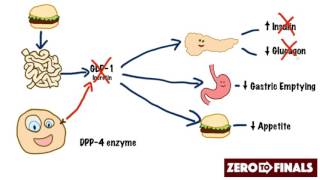 How does sitagliptin work? DPP-4 inhibitors and GLP-1 mimeticsIn this short explainer from the channel, the presenter, the speaker, describes two types of medication used in the treatment of type 2 diabetes: DPP-4 inhibitors and GLP-1 mimetics.
 How do GLP-1 Drugs (Ozempic, Mounjaro, Zepbound) Work?In this short explainer, the channel describes how GLP-1 drugs work, using Ozempic, Mounjaro and Zepbound as the examples in the title.
Read next
Our guides closest to what this video covers, with prices checked weekly.
- What is GLP-1? The hormone, how the drugs work, and every GLP-1 medication on the market
GLP-1 stands for glucagon-like peptide-1, a hormone your gut releases after you eat. It tells the pancreas to release insulin when blood sugar is high, holds back glucagon, slows how fast the stomach empties, and acts on the parts of the brain that regulate appetite. GLP-1 drugs copy that hormone but last far longer: a week for the injections, a day for the pills. Seven brands are on the US market, from Ozempic and Mounjaro for type 2 diabetes to Wegovy, Zepbound and Foundayo for weight loss.
- GLP-1 vs GLP-2 vs GLP-3: what the names mean, and which ones you can actually buy
GLP-1 drugs such as semaglutide act on one receptor. "GLP-2" is used online for tirzepatide (Zepbound, Mounjaro), which acts on two, GIP and GLP-1, and "GLP-3" for retatrutide, which adds the glucagon receptor. Neither nickname is the real name: GLP-2 is a separate gut hormone whose drug, Gattex, treats short bowel syndrome. Retatrutide produced 28.3% mean weight loss at 80 weeks in its phase 3 trial but is not FDA-approved; Lilly plans to file in Q1 2027. Tirzepatide is the strongest option you can buy today.
- GLP-1 supplements: what the boosters are, what they did in trials, and what the real drug costs
No GLP-1 supplement contains a GLP-1 drug. Products sold as GLP-1 boosters, gummies or natural GLP-1 are dietary supplements, usually built on berberine, fiber or probiotics, and FDA does not approve them before they are sold. In trials, berberine averaged about 2 lb (0.88 kg) more weight loss than control across 23 studies; semaglutide, the drug in Wegovy, averaged about 28 lb (12.7 kg) more than placebo at 68 weeks. A real GLP-1 needs a prescription, and the cheapest cash program on our board is $39 a month.
Next steps
Compounded semaglutide prices
Find more like it
Food noise and cravingsHow it works
Up next
More from this collection








Watched it? See what it costs.
Every GLP-1 program we track, ranked by what actually leaves your account.