GLP-1 TV · News & media · views checked Oct 2026
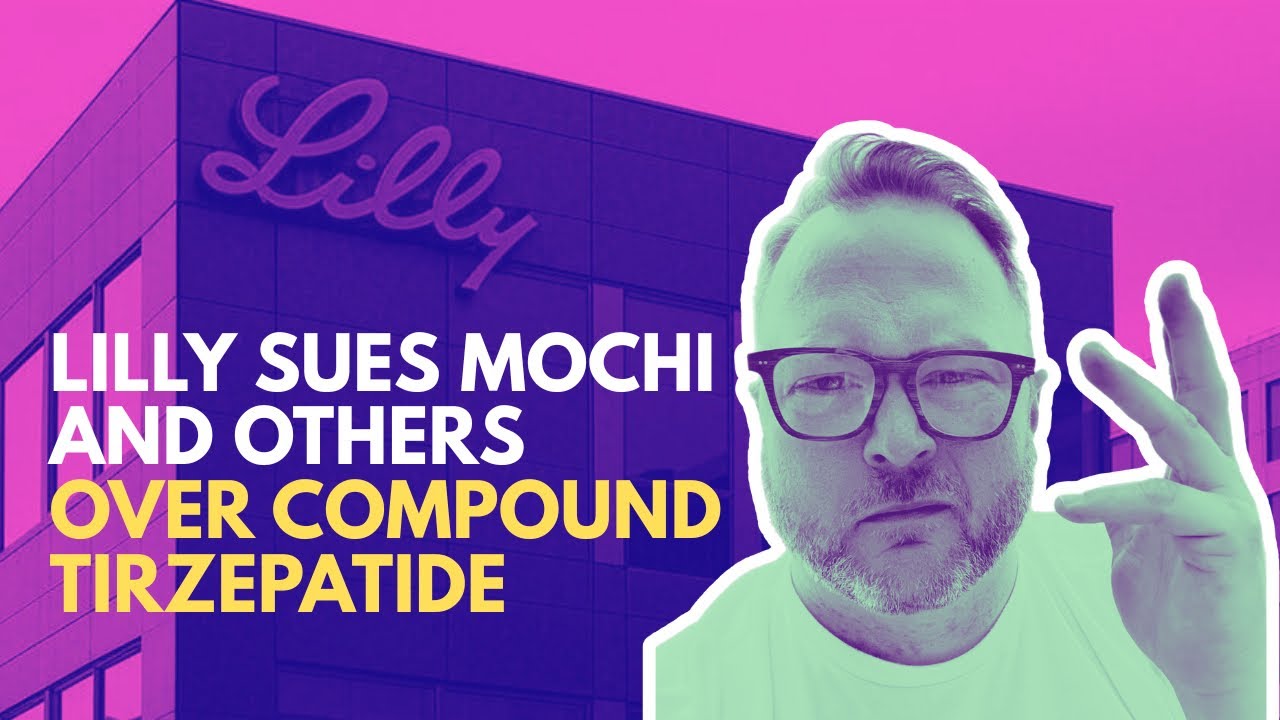
🚨 BREAKING Compound Tirzepatide News: Lilly Sues Mochi Health and Others!
News & media
Our summary
According to the video, Eli Lilly has filed lawsuits in district court in California against four telehealth companies that offer compounded tirzepatide: Mochi Health, Fella and Delilah Health, Willow Health Services, and Henry Meds. Host Dave Napp says the suits target compounded versions in the 503A category, which are made or mixed with other ingredients such as amino acids or vitamins. He says Lilly frames this as a safety issue because these products have not been evaluated or cleared by the FDA, and that as far as he can tell Lilly is not alleging patent infringement.
General education as published by the channel. Not medical advice, and not an endorsement.
Where tirzepatide costs least today
The three cheapest partner programs for tirzepatide, all in per month, checked weekly.



What else the video covers
Napp says the filings take a different angle from earlier actions. Lilly alleges the telehealth platforms steer patients toward compounded drugs without adequate medical evaluation, often through pre-filled templates or quick online forms. The concern described is that the companies may put sales ahead of safety and influence doctors to prescribe in bulk or outside standard clinical judgment. He notes that earlier cease and desist letters went to med spas, prescribers and some pharmacies.
Napp also places the news in a wider context. He describes the 503A market as the natural result of the 503B mass compounding ending with the shortage, and mentions telehealth offers combining tirzepatide with semaglutide. He points to a court date on Thursday in the tirzepatide case between the OFA and the FDA. He questions why pharma objects to how compounds are prescribed, comparing it with long-standing pharma influence such as lunch and learns, paid speakers and free samples. The video ends with promotion of his site, email alerts and a trip to DC.
Our summary of what is said, in our words. Doses, results and prices are the speaker’s, not advice.
Takeaways
The main points, in the order they come up. Tap a time to play from there.
- 0:01 Dave Napp reports that Eli Lilly has sued four telehealth companies that offer compounded tirzepatide.
- 1:33 The named defendants are Mochi Health, Fella and Delilah Health, Willow Health Services, and Henry Meds, in California district court.
- 2:05 Lilly frames the suits as a safety issue about 503A compounded versions that the FDA has not evaluated, and is not alleging patent infringement as far as he can tell.
- 2:36 Lilly also alleges the platforms steer patients to compounds using templates or quick online forms without adequate medical evaluation.
- 4:40 Napp says some telehealth companies are marketing tirzepatide combined with semaglutide, and a court day in the OFA versus FDA case is set for Thursday.
- 5:42 He argues that pharma has long influenced prescribing through lunches, paid speakers and free samples, so criticism of telehealth prescribing seems inconsistent.
Key moments
From the creator's own chapters. Tap one to play from there.
What the video says
As stated in the video, not checked by us. Doses and results are the speaker’s, not advice.
- Medication
- Wegovy, Zepbound and tirzepatide
- Who is speaking
- News or media
Questions this video answers
Which telehealth companies did Eli Lilly sue over compounded tirzepatide?
According to the video, the four targets are Mochi Health, Fella and Delilah Health, Willow Health Services, and Henry Meds. The suits were filed in district court in California.
What is Eli Lilly alleging in the compounded tirzepatide lawsuits?
The host says Lilly calls the 503A compounded versions a safety issue because the FDA has not evaluated them. Lilly also alleges the companies steer patients to compounds without adequate medical evaluation, using pre-filled templates or quick online forms. The host says he does not see a patent infringement claim.
Are the Lilly lawsuits about patent infringement?
Napp says that as far as he can tell, Lilly is not alleging patent infringement. He says the company is instead framing the matter as one of safety and of how the drugs are prescribed.
Videos on the same question
The closest videos in the library by what is said in them, not by title.
 GLP-1s Won in Court? Lilly’s Lawyers HUMILIATED in Mochi Health CaseChristopher Durham of the DOWNSIZED channel reviews the hearing in Eli Lilly's lawsuit against Mochi Health, held in a San Francisco courtroom.
 Your GLP-1 Compound Access Could Be At Risk… (Lilly vs Mochi Update)This episode of On The Pen is an interview with Sabina Hemmi, who attended the most recent court hearing in Eli Lilly's lawsuit against Mochi Health.
 END OF TIRZEPATIDE COMPOUNDING? FDA Removes Zepbound and Mounjaro from Shortage List!In this short video, Dr. Christy Risinger explains what it means that the FDA has taken tirzepatide, sold as Zepbound and Mounjaro, off its drug shortage list.
 Compound Tirzepatide Safety: What You Can DoIn this live stream from On The Pen, host Dave Knapp says patients taking compounded GLP-1 medications have had no clear way to learn where the active pharmaceutical ingredient (API) in their drug comes from.
About On The Pen™ GLP-1 News
News & media, 37.5K subscribers. 41 of their videos are in GLP-1 TV, 468K views between them, mostly on Zepbound, Compounded tirzepatide, Mounjaro.
- Zepbound Dosing: Your Doctor Probably Didn't Tell You About This Issue
- Mounjaro 2.5 mg Review
- Zepbound KwikPen
Read next
Our guides closest to what this video covers, with prices checked weekly.
- Compounded tirzepatide: what it is, what FDA says now the shortage is over, and what it costs against Zepbound
Compounded tirzepatide is Zepbound's molecule made by a licensed pharmacy rather than Lilly, sold through telehealth programs from $85 a month on our board against Lilly's $299 to $699 ($449 on the KwikPen from 7.5 mg with on-time refills). It is not FDA-approved, and the legal ground under it has shifted: FDA says tirzepatide no longer appears on its shortage list, which was the condition that let pharmacies compound copies of an approved drug at scale. What remains is compounding for individual patients, FDA's list of specific concerns about how these products are dosed, shipped and labelled, and a price gap large enough that most cash buyers take the trade anyway. This page sets all of that out.
- Generic tirzepatide: there is none, the patent runs to 2036, and here is what costs less today
There is no generic tirzepatide, generic Zepbound or generic Mounjaro, and FDA's Orange Book shows why: Lilly's patent on the molecule runs to May 13, 2036, with formulation and use patents to 2039 and 2041. Until then the legal routes are Lilly's own self-pay prices, from $299 a month for Zepbound, and compounded tirzepatide, which is not FDA-approved and starts at $85 a month on our board.
- Retatrutide: up to 28.3% weight loss in trials, no FDA approval yet, and no legal way to buy it today
Retatrutide is Eli Lilly's experimental weekly injection that acts on three hormone receptors (GIP, GLP-1 and glucagon). In the phase 3 TRIUMPH-1 trial, people on the 12 mg dose lost 28.3% of their weight at 80 weeks by Lilly's efficacy measure (25.0% counting everyone randomized). It is not FDA-approved, has no price, and cannot legally be sold. Lilly plans to file with FDA in Q1 2027. Tirzepatide is the closest thing you can buy now, compounded from $85 a month on our board.
Find more like it
Up next
More from this collection






Watched it? See what it costs.
Every GLP-1 program we track, ranked by what actually leaves your account.