




GLP-1 TV
‘Maintenance’ doses of GLP-1 medication | Ohio State Medical Center
Today’s cheapest GLP-1$39/mo at Wellmedr, sale price.Compare all GLP-1 prices Price read 23 Nov 2026 from the seller’s own page, ranked by price alone. That price is a compounded drug, and compounded drugs are not FDA-approved. Not from the video’s creator.Our summary
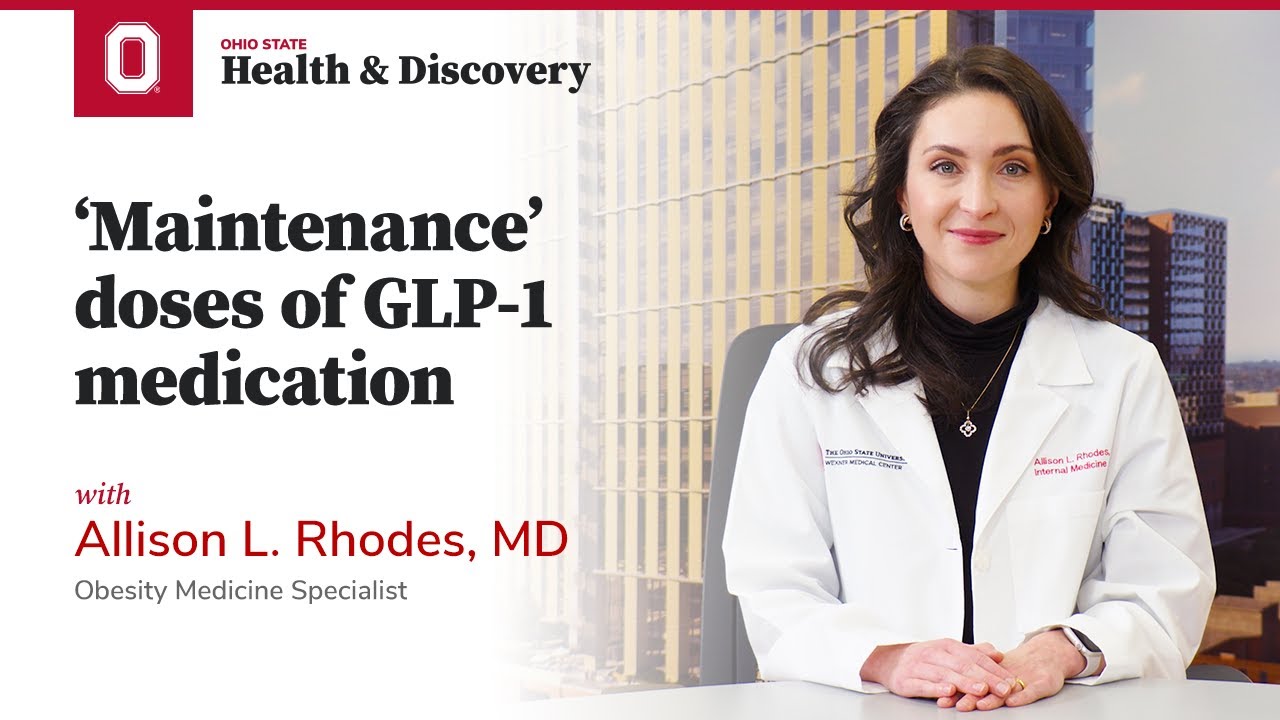
In this short the channel video, a clinician in obesity medicine talks about maintenance doses of GLP-1 receptor agonist medications. The speaker says the two medications currently available, semaglutide and tirzepatide, each come with approved maintenance doses. These are the doses patients ideally reach through a step-up (uptitration) schedule, after which they work with their physician to decide which dose is best to stay on long term.
Published by Ohio State Wexner Medical Center on YouTube
As published by the channel. Not medical advice, and not an endorsement.
What else the video covers
The speaker explains why this matters: each person responds differently. According to the video, some patients lose a good amount of weight on a lower dose, while others need to move all the way up to the highest dose before they see meaningful weight loss. Having maintenance doses gives patients a way to step off the escalation schedule and stay on a dose that works for them. The speaker lists the approved maintenance doses as 1.7 mg and 2.4 mg for semaglutide, and 5 mg, 10 mg and 15 mg for tirzepatide.
The speaker also addresses people thinking about using a lower dose for a limited time. They say that if the plan is to use a lower dose and then stop, without reaching or staying on a maintenance dose, it is important to consider other options for weight loss. The reason given is that the risk of regaining weight after stopping these medications is high, even on a lower dose. The speaker hopes future medications will let patients take the lowest effective amount needed to maintain their weight.
Our summary of what is said, in our words. Doses, results and prices are the speaker’s, not advice.
Takeaways
The main points, in the order they come up. Tap a time to play from there.
- 0:02 The speaker says semaglutide and tirzepatide both have approved maintenance doses, which patients ideally reach through an uptitration schedule.
- 0:33 The speaker explains that responses differ, with some patients losing weight on a lower dose and others needing the highest dose.
- 1:03 The approved semaglutide maintenance doses are 1.7 mg and 2.4 mg, and the tirzepatide doses are 5 mg, 10 mg and 15 mg, according to the speaker.
- 1:12 The speaker advises that anyone planning to use only a lower dose and then stop should consider other weight loss options.
- 1:34 The speaker says the risk of weight regain after stopping is high, even on a lower dose.
- 1:47 The speaker hopes future medications will allow patients to use the lowest effective amount to maintain their weight.
Key moments
Tap one to play from there.
Questions this video answers
What are the maintenance doses of semaglutide?
According to the speaker, the two approved maintenance doses of semaglutide are 1.7 mg and 2.4 mg. Patients ideally reach these through an uptitration schedule and then work with their physician to decide which is best long term.
What are the maintenance doses of tirzepatide?
The speaker states that the approved maintenance doses of tirzepatide are 5 mg, 10 mg and 15 mg. The video says the best long-term dose is determined with a physician.
Why are there different maintenance doses for GLP-1 medications?
The speaker says each person responds differently. Some patients may lose a good amount of weight on a lower dose, while others need to escalate to the highest dose before meaningful weight loss. Maintenance doses give patients a way to stop escalating and stay on a dose that works.
Is the risk of weight regain high after stopping a GLP-1 medication on a low dose?
The speaker says the risk of weight regain when stopping these medications is high, even when using a lower dose. They suggest that people planning to use only a lower dose and then stop should consider other options for weight loss.
Videos on the same question
The closest videos in the library by what is said in them, not by title.
 How GLP-1 Dosing Really Works! (Obesity Doctor)In this video, the speaker, who says she is board certified in internal medicine, lifestyle medicine and obesity medicine, explains how dosing works for semaglutide and tirzepatide, which she calls the most popular GLP-1 medications at the time of filming.
- Already on a GLP-1? What your next month costs at every programToday’s lowest is $39/mo. Every program ranked by price alone. Compounded drugs are not FDA-approved.
 Don't Increase Your Semaglutide Dose Until You Watch This | A Doctor ExplainsIn this video, the speaker, an obesity medicine provider who says they have prescribed GLP-1 medications since 2021 and also uses tirzepatide, argues that raising the dose of tirzepatide or semaglutide is usually the wrong response to a stalled scale.
 MAINTENANCE IS HARD : Glp1 maintenance part 2: dosage, goal setting and staying focused The speaker, who says she has lost 115 lb on a GLP-1 and has been in maintenance for about a year and a half within plus or minus 5 lb, presents part two of her maintenance series.
 Dial in Your Dose: Ozempic & Mounjaro Maintenance TipsThe channel, explains how he approaches maintenance dosing once someone on a GLP-1 medication reaches a goal weight.
 GLP-1 Timeline: When Hunger Finally Stops | Doctor ExplainsThe speaker opens a mini series on GLP-1 dosing by covering what he calls the traditional, scientifically proven protocol: weekly subcutaneous injections that follow each medication's schedule, with increases monthly until peak weight loss is reached.
 Ozempic & Tirzepatide Maintenance Dose: Get It Wrong, the Weight Comes Back | A Doctor ExplainsThe speaker, an obesity medicine provider who says they have prescribed GLP-1 medications since 2021 and now take tirzepatide themselves, explains what to do after reaching a goal weight on semaglutide or tirzepatide.
Read next
Our guides closest to what this video covers, with prices checked weekly.
- Stopping a GLP-1: what the withdrawal trials found, and what a maintenance dose actually is
Two trials have measured what happens when you stop. On semaglutide, people who lost 17.3% over 68 weeks regained two-thirds of it in the year after stopping, ending 5.6% below where they started. On tirzepatide, people who lost 20.9% in 36 weeks regained 14% over the next year on placebo while those who continued lost a further 5.5%. Both labels are explicit that these drugs are for maintaining weight reduction long term, which is a different claim from finishing a course. A maintenance dose is simply the dose you stay on; the labels do not define a lower one to step down to at goal.
- GLP-1 dosage chart: every brand's starting dose, step-ups and top dose, straight from the FDA labels
Every GLP-1 label starts low and climbs. The weekly shots start at 0.25 mg (Wegovy, Ozempic) or 2.5 mg (Zepbound, Mounjaro) and step up no faster than every 4 weeks, to a top dose of 7.2 mg, 2 mg or 15 mg. The daily pills climb in 30-day steps: Wegovy pill 1.5 to 25 mg, Ozempic pill 1.5 to 9 mg, Rybelsus 3 to 14 mg, Foundayo 0.8 to 17.2 mg. No label converts one drug's milligrams into another's.
- GLP-1 vs GLP-2 vs GLP-3: what the names mean, and which ones you can actually buy
GLP-1 drugs such as semaglutide act on one receptor. "GLP-2" is used online for tirzepatide (Zepbound, Mounjaro), which acts on two, GIP and GLP-1, and "GLP-3" for retatrutide, which adds the glucagon receptor. Neither nickname is the real name: GLP-2 is a separate gut hormone whose drug, Gattex, treats short bowel syndrome. Retatrutide produced 28.3% mean weight loss at 80 weeks in its phase 3 trial but is not FDA-approved; Lilly plans to file in Q1 2027. Tirzepatide is the strongest option you can buy today.
Next steps
Compounded semaglutide prices
Find more like it
Dose changeStopping and maintenance
Up next
More from this collection








Watched it? See what it costs.
Every GLP-1 program we track, ranked by what actually leaves your account.