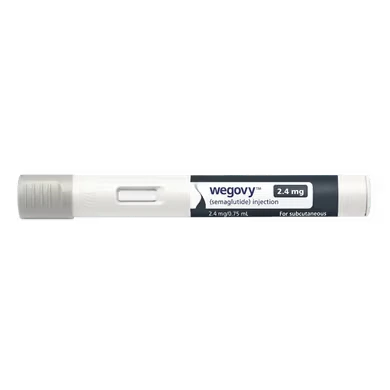

CagriSema is not approved, and nobody can sell it to you legally yet. Novo Nordisk filed it with the FDA on December 18, 2025, expects a decision in the fourth quarter of 2026, and plans a full US launch at the start of 2027 if the answer is yes. It has no published price. In its main trial people lost 20.4% of their body weight on average at 68 weeks, more than semaglutide alone, but in the head-to-head trial against tirzepatide (the drug in Zepbound) it came second, 20.2% against 23.6%. Below: what it is, every trial figure with the way it was counted, the dated FDA timeline, what is and is not known about price, how it compares with Wegovy and Zepbound, and what you can buy today.
What is CagriSema?
CagriSema is two drugs in one weekly injection. Novo's filing describes it as "a fixed-dose combination of a long-acting amylin analogue, cagrilintide 2.4 mg, and the GLP-1 receptor agonist, semaglutide 2.4 mg."1 Semaglutide is the molecule already sold as Wegovy and Ozempic, and 2.4 mg is the Wegovy maintenance strength. Cagrilintide is the new part.
Amylin is a hormone the pancreas releases alongside insulin after a meal. Cagrilintide is a long-acting copy of it, built to last a week. GLP-1 drugs and amylin act on appetite through different receptors, which is the reason for pairing them. Novo's own one-line summary of the effect: "The two molecules induce weight loss by reducing hunger, increasing feelings of fullness and thereby help people eat less and reduce their calorie intake."6 If the FDA approves it, Novo says it "would become the first injectable GLP-1 receptor agonist and amylin analogue combination treatment."1
Three things it is not. It is not a new kind of semaglutide; the semaglutide inside is the same molecule. It is not tirzepatide, which acts on GIP and GLP-1 receptors and never touches amylin (our GLP-1 vs "GLP-2" vs "GLP-3" explainer sorts out those names). And it is not a pill: every trial so far used a once-weekly injection under the skin.
Is CagriSema FDA approved?
No. As of October 8, 2026, the FDA has not approved CagriSema for any use. Novo's own boilerplate, in the filing announcement, reads: "CagriSema is not approved in the US or EU."1 The September 21, 2026 trial announcement still calls it "an investigational product" and repeats that "A decision is expected in Q4 2026."7
What was filed is narrow. The application covers the 2.4 mg/2.4 mg dose for weight management in adults with obesity, or overweight with at least one weight-related condition, alongside diet and exercise.1 It rests on two trials, REDEFINE 1 and REDEFINE 2.6 A type 2 diabetes approval is a separate question: after its REIMAGINE results Novo said it "will approach authorities to discuss the regulatory pathway for CagriSema in type 2 diabetes", which means no diabetes filing yet.9
When will CagriSema be available?
On Novo's stated plan, early 2027 at the soonest, and only if the FDA says yes. At its Capital Markets Day on September 21, 2026, Novo's US team wrote: "FDA regulatory decision expected in Q4 2026" and "Pending decision, full launch expected during start of 2027."8 The same slide sets the goal of "a successful launch of CagriSema early next year".8
Novo has not published a PDUFA date, the FDA's target date for a decision, and we will not guess one. Its wording has stayed consistent: "an FDA decision is anticipated by late 2026" in February,6 "Q4 2026" in September.7 The FDA can approve, ask for more data, or extend a review, so until there is an approval letter, treat every launch date, including Novo's, as a plan.
Anyone selling "CagriSema" today, by injection, vial or "kit", is not selling an FDA-approved product, because none exists. The section on research-chemical cagrilintide below covers what the FDA says about those.
CagriSema trial results, with how each number was counted
Every obesity trial reports two weight-loss numbers, and the gap between them explains most of the confusion online. Novo's announcements label them; we keep their labels.
- Everyone counted (Novo calls it the treatment-policy or treatment-regimen estimand): the average across everyone randomised, including people who stopped the drug or skipped doses. The NEJM papers use this one as their main result.23 It is the closer guide to what happens in real life.
- If everyone stayed on it (the trial-product or efficacy estimand): Novo's footnote describes it as "Based on the efficacy estimand according to the trial protocol, regardless of dose modification".6 It is always the bigger number, and it is the one most headlines quote.
| Trial (who was in it) | Weeks | Everyone counted | If everyone stayed on it | Comparison |
|---|---|---|---|---|
| REDEFINE 1 (3,417 adults with obesity or overweight, no diabetes) | 68 | 20.4% | 22.7% | placebo 3.0% / 2.3%; semaglutide alone 14.9% / 16.1%; cagrilintide alone 11.5% / 11.8%4 |
| REDEFINE 2 (1,206 adults with type 2 diabetes) | 68 | 13.7% | 15.7% | placebo 3.4% / 3.1%35 |
| REDEFINE 4 (809 adults with obesity, open label) | 84 | 20.2% | 23.0% | tirzepatide 15 mg 23.6% / 25.5%6 |
| REDEFINE 5 (331 adults in Japan and Taiwan) | 68 | not reported in the abstract | 18.4% | semaglutide 2.4 mg 11.9%10 |
| REIMAGINE 2 (2,728 adults with type 2 diabetes) | 68 | 12.9% | 14.2% | semaglutide 2.4 mg 9.2% / 10.2%9 |
| REDEFINE 9 (lower 1.0 mg/1.0 mg dose) | 68 | not yet published | 21.0% | placebo 2.0%7 |
| REIMAGINE 5 (type 2 diabetes, 1.0 mg/1.0 mg dose) | 60 | not yet published | 12.4% | tirzepatide 5 mg 9.1%7 |
Four details that the headline numbers leave out.
- Only 57% of people in REDEFINE 1 ended on the full dose. The protocol let people step down. Novo reported that "After 68 weeks, 57.3% of patients treated with CagriSema were on the highest dose compared to 82.5% with cagrilintide 2.4 mg and 70.2% with semaglutide 2.4 mg."4
- The big-loss tail is real. If everyone had stayed on it, "40.4% of patients who received CagriSema reached a weight loss of 25% or more after 68 weeks".4
- Diabetes lowers the number, as it does for every drug in this class. REDEFINE 2's 13.7% sits well below REDEFINE 1's 20.4%. Blood sugar moved too: 73.5% on CagriSema reached an HbA1c of 6.5% or less, against 15.9% on placebo.3
- The trials were published. REDEFINE 1 and 2 were presented at the American Diabetes Association's meeting on June 22, 2025 and "simultaneously published in the New England Journal of Medicine."17 REDEFINE 5 followed in The Lancet Diabetes & Endocrinology in 2026.10
CagriSema vs tirzepatide: what REDEFINE 4 showed
This is the trial Novo designed to show CagriSema was at least as good as Lilly's tirzepatide, and it did not. REDEFINE 4 put 809 people with obesity on either CagriSema 2.4 mg/2.4 mg or tirzepatide 15 mg, the top Zepbound dose, for 84 weeks.6 Counting everyone, CagriSema averaged 20.2% weight loss and tirzepatide 23.6%. If everyone had stayed on treatment, 23.0% against 25.5%. In Novo's words: "The trial did not achieve its primary endpoint of demonstrating non-inferiority on weight loss for CagriSema compared to tirzepatide after 84 weeks."6
Two caveats Novo itself flags. The trial was open label: "all investigators and participants were aware of the specific drug administered throughout the trial."6 People who know they are on the better-known drug may stay on it longer, which can tilt results either way. And the comparison was between the top doses of both drugs, at one point in time.
Then, on September 21, 2026, Novo announced a second head-to-head result that points the other way at lower doses. In REIMAGINE 5, in people with type 2 diabetes, "CagriSema 1.0 mg/1.0 mg was superior to tirzepatide 5 mg for weight loss, achieving an estimated average weight loss of 12.4%, compared with 9.1%".7 Blood sugar control was a tie on Novo's test: HbA1c fell 1.71% on CagriSema and 1.67% on tirzepatide, which Novo reported as non-inferior.7 Note what was compared: CagriSema's low dose against tirzepatide's starting dose, counted as if everyone stayed on treatment, and only in a press release so far.
| Head to head | CagriSema | Tirzepatide | Result |
|---|---|---|---|
| REDEFINE 4, obesity, top doses, 84 weeks, everyone counted | 20.2% | 23.6% | tirzepatide ahead; non-inferiority not shown6 |
| REDEFINE 4, same trial, if everyone stayed on it | 23.0% | 25.5% | tirzepatide ahead6 |
| REIMAGINE 5, type 2 diabetes, 1.0/1.0 mg vs 5 mg, 60 weeks | 12.4% | 9.1% | CagriSema ahead on weight; HbA1c non-inferior7 |
So the plain answer to "CagriSema vs tirzepatide": at the doses Novo has filed, tirzepatide produced more weight loss in the one direct obesity trial. Novo's response is a stronger dose. A phase 3 trial of "High-dose CagriSema 2.4 mg/7.2 mg", pairing cagrilintide with the 7.2 mg semaglutide strength now sold as Wegovy HD, "is planned to be initiated in the second half of 2026".6 Novo expects its results in the first half of 2028.8 Our Wegovy 7.2 mg guide covers that higher semaglutide strength on its own.
CagriSema vs Wegovy and Zepbound, on published numbers
The fairest comparison with Wegovy happens inside a single trial. REDEFINE 1 had a semaglutide-alone arm at the Wegovy dose, randomised and double-blind alongside CagriSema: 14.9% against 20.4%, everyone counted.24 REDEFINE 5 tested the same pairing head to head in 331 adults in Japan and Taiwan and found 18.4% against 11.9%, if everyone stayed on treatment.10 Both trials say the cagrilintide adds roughly five to six and a half points of weight loss on top of semaglutide.
Against Zepbound, the only direct obesity evidence is REDEFINE 4 above. For a wider view, here are the original approval trials for Wegovy and Zepbound next to REDEFINE 1, each counted the "everyone counted" way.
| Drug (trial) | Dose | Weeks | Average weight loss, everyone counted | Placebo |
|---|---|---|---|---|
| CagriSema (REDEFINE 1) | 2.4 mg/2.4 mg | 68 | 20.4% | 3.0%2 |
| Wegovy, semaglutide (STEP 1) | 2.4 mg | 68 | 14.9% | 2.4%12 |
| Zepbound, tirzepatide (SURMOUNT-1) | 15 mg | 72 | 20.9% | 3.1%13 |
Read this table with one rule: these are different trials, run years apart, on different people, and a cross-trial comparison cannot rank the drugs. STEP 1's primary estimand "assessed effects regardless of treatment discontinuation or rescue interventions",12 and SURMOUNT-1's "assessed effects regardless of treatment discontinuation in the intention-to-treat population",13 so the method lines up with REDEFINE 1's treatment-policy result.2 The populations and durations do not. One reassuring cross-check: semaglutide alone produced exactly 14.9% in both STEP 1 and REDEFINE 1's semaglutide arm.412 For the existing two drugs side by side, see Zepbound vs Wegovy.
Side effects and safety so far
Mostly the stomach, as with every drug built on GLP-1. In REDEFINE 1, Novo reports gastrointestinal adverse events in "79.6% in the CagriSema group vs 39.9% with placebo", "including nausea (55% vs 12.6%), constipation (30.7% vs 11.6%), and vomiting (26.1% vs 4.1%)."1 Stopping because of side effects was less common than those rates suggest: "5.9% for CagriSema versus 3.5% for placebo in REDEFINE 1 and 8.4% with CagriSema versus 3% with placebo in REDEFINE 2."1 In REDEFINE 2, 72.5% on CagriSema reported a gastrointestinal event against 34.4% on placebo, "most of which were transient and mild or moderate in severity."3
The heart question is still open. REDEFINE 3, the cardiovascular outcomes trial, has randomised "7076 adults at 575 sites in 24 countries", all with established heart or blood vessel disease, and is testing whether CagriSema is at least as safe as placebo on heart attack, stroke and cardiovascular death.11 Its design paper was published on October 6, 2026; results are not out. A full label with warnings will exist only if the FDA approves the drug. Questions about whether CagriSema would suit you belong with a prescriber once it is on the market.
How much will CagriSema cost?
Nobody knows yet, because Novo has not said. None of the CagriSema announcements we read, from the December 2025 filing through the September 2026 Capital Markets Day, names a list price, a self-pay price or an insurance plan.178 Any dollar figure you see quoted for CagriSema today is someone's estimate.
What Novo has said is where it plans to sell it: "Drive consumer efforts via Novocare® and with partners".8 NovoCare is Novo's own cash-pay pharmacy, and today it is the cheapest direct route to Wegovy. New patients there pay $199 for each of the first two months at the two lowest strengths, through December 31, 2026, "then $349 per month" for the standard Wegovy doses and "$399 per month" for Wegovy HD 7.2 mg.15 That is Novo's current price ladder for semaglutide alone. Whether a drug that contains semaglutide plus a second patented molecule launches at, above or near those numbers is Novo's call, and we will add the figure here, with its source, when Novo publishes one.
Two things will not happen at launch. There will be no generic: cagrilintide is a new molecule, and our generic semaglutide guide explains why semaglutide has none in the US either. And there will be no legal compounded CagriSema: the FDA states that cagrilintide "cannot be used in compounding under federal law".14
"Research peptide" cagrilintide sold online
Search for cagrilintide and you will find websites selling vials of it, sometimes pre-mixed with semaglutide, labelled "for research use only". These are not CagriSema and they are not legal medicine. The FDA's position, in full: "Retatrutide and cagrilintide cannot be used in compounding under federal law. Additionally, these are not components of FDA-approved drugs and have not been found safe and effective for any condition."14
The "research" label does not change that. Writing about unapproved GLP-1 drugs falsely labelled "for research purposes" or "not for human consumption", the FDA says: "These products have been sold directly to consumers for human use with dosing instructions. The agency urges consumers not to purchase these products which are of unknown quality and may be harmful to their health."14 Unapproved versions, it adds, "do not undergo FDA's review for safety, effectiveness and quality before they are marketed."14 We do not link to any of these sellers, and no program on our board sells cagrilintide. If a telehealth company offers you "CagriSema" or "cagri-sema" before an FDA approval, it is offering an unapproved drug. Our seller legitimacy check lists the other warning signs.
CagriSema timeline
| Date | What happened, or is planned | Source |
|---|---|---|
| December 20, 2024 | REDEFINE 1 headline: 22.7% if everyone stayed on it, 20.4% counting everyone | Novo4 |
| March 10, 2025 | REDEFINE 2 headline: 15.7% / 13.7% in type 2 diabetes; Novo then expected to file in Q1 2026 | Novo5 |
| June 22, 2025 | REDEFINE 1 and 2 presented at the ADA meeting and published in NEJM | ADA17 |
| December 18, 2025 | New Drug Application submitted to the FDA, ahead of the Q1 2026 plan | Novo1 |
| February 2, 2026 | REIMAGINE 2: 14.2% weight loss in type 2 diabetes, ahead of semaglutide alone | Novo9 |
| February 23, 2026 | REDEFINE 4: 20.2% against tirzepatide's 23.6%; non-inferiority not shown | Novo6 |
| April 17, 2026 | REDEFINE 5 published online: 18.4% against semaglutide's 11.9% | Lancet D&E10 |
| September 21, 2026 | REIMAGINE 5 (beats tirzepatide 5 mg at the 1.0/1.0 mg dose) and REDEFINE 9 (21.0% at 1.0/1.0 mg) | Novo7 |
| October 6, 2026 | REDEFINE 3 heart-outcomes design published; 7,076 people enrolled | Am Heart J11 |
| Q4 2026 | FDA decision expected | Novo78 |
| Second half of 2026 | High-dose CagriSema 2.4 mg/7.2 mg phase 3 trial to start | Novo6 |
| Start of 2027 | Full US launch expected, pending the FDA decision | Novo8 |
| First half of 2027 | REDEFINE 11 results (longer trial, 2.4/2.4 mg) | Novo68 |
| First half of 2028 | High-dose CagriSema results | Novo8 |
What to use while you wait
CagriSema's main ingredient is already on sale. If you want semaglutide now, there are three routes, each priced from today's data. FDA-approved Wegovy starts at $208 a month through programs on our board, and Novo's NovoCare price is $199 for each of the first two months, then $349 a month for the standard pens.15 Compounded semaglutide, which is made by a licensed pharmacy and is not FDA-approved, starts at $69 a month on our board, about $830 a year. If the tirzepatide result in REDEFINE 4 is what matters to you, Zepbound is approved now and sells through programs on our board from $358 a month; Lilly's own LillyDirect price starts at $299 a month, rising to $449 at higher strengths if you refill within 45 days.16
| Route | Paying cash, per month | FDA-approved product? |
|---|---|---|
| CagriSema | not for sale; no price published | not yet, decision expected Q4 2026 |
| Compounded semaglutide, cheapest program on our board | $69 | no |
| Wegovy through a program on our board | from $208 | yes |
| Wegovy direct from NovoCare | $199 for two months, then $349 | yes |
| Zepbound through a program on our board | from $358 | yes |
| Zepbound direct from LillyDirect | $299 to $449 refilled on time | yes |
On the semaglutide side, the cheapest compounded program costs less than NovoCare's standard $349 Wegovy price, at the cost of FDA review of the finished product. Every semaglutide program we track, cheapest first:
And the programs that prescribe brand Zepbound:
Starting semaglutide now does not lock you out of CagriSema later; whether and how to switch after an approval is a decision for your prescriber, with the label in hand. The cheapest semaglutide page keeps the ranking above current between visits.
The short version
CagriSema pairs semaglutide with cagrilintide, a weekly amylin analogue, and in REDEFINE 1 it beat semaglutide alone by about five and a half points, 20.4% against 14.9% counting everyone. Head to head at full dose it did not match tirzepatide, 20.2% against 23.6%. Novo filed on December 18, 2025, expects the FDA's answer in Q4 2026 and plans a full launch at the start of 2027. There is no price, no generic and no legal compounded version, and the "research" cagrilintide sold online is, in the FDA's words, not "found safe and effective for any condition." Until it launches, semaglutide is on sale from $69 a month compounded, or as Wegovy from $208.