GLP-1 TV · News & media · views checked Oct 2026
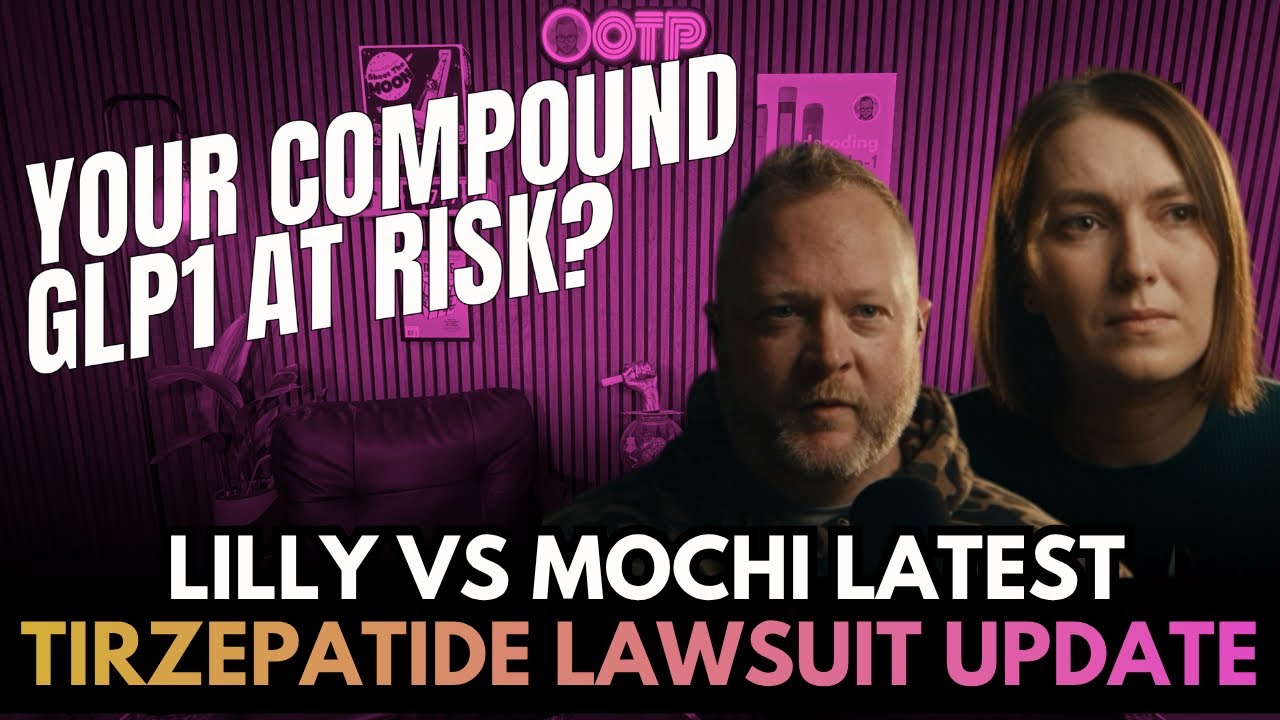
Your GLP-1 Compound Access Could Be At Risk… (Lilly vs Mochi Update)
News & media
Our summary
This episode of On The Pen is an interview with Sabina Hemmi, who attended the most recent court hearing in Eli Lilly's lawsuit against Mochi Health. She explains why the case matters for people who get compounded GLP-1 medications through telehealth: a ruling could affect the wider compounding industry. According to her, Lilly is not suing over patents. Its claims center on confusing marketing, reputational harm, lost sales and corporate practice of medicine.
General education as published by the channel. Not medical advice, and not an endorsement.
Where tirzepatide costs least today
The three cheapest partner programs for tirzepatide, all in per month, checked weekly.



What else the video covers
She says the judge opened the hearing by saying Lilly now has some standing, which she calls a change from the first hearing, when the judge was skeptical. She thinks the case is likely to move forward in part. In her view, the corporate practice of medicine claims are less likely to survive, because that is normally enforced by a state medical board. She also describes an exchange in which Lilly's lawyer raised Lilly Direct as a competitor, and says the judge moved to strike that from the discussion. If the case is not dismissed, she says a trial probably would not start until 2027, and that even a pending case could have a chilling effect on telehealths and compounding pharmacies.
The second half covers other risks to compounded access. Hemmi says her biggest concern is possible FDA enforcement changes affecting 503B outsourcing facilities, citing ProRx being told to stop compounding GLP-1s. The host suggests this may relate to inspection findings. She also raises California bill AB 1990, which she says would restrict GLP-1 medications and which she thinks legislators do not fully understand. She closes by describing her upcoming tour of compounding pharmacies in Houston.
Our summary of what is said, in our words. Doses, results and prices are the speaker’s, not advice.
Takeaways
The main points, in the order they come up. Tap a time to play from there.
- 0:00 The hosts say the outcome of Lilly v. Mochi could have ripple effects for compounded GLP-1 access through telehealth.
- 2:00 Hemmi says Lilly's claims are about marketing confusion, reputational harm and lost sales rather than patents.
- 15:00 She expects the case to move forward at least in part, noting the judge said Lilly has some standing.
- 19:00 She says that if the case proceeds, a trial probably would not begin until 2027.
- 21:50 Her top concern is FDA enforcement on 503B facilities, citing ProRx being told to stop compounding GLP-1s.
- 26:40 She also flags California bill AB 1990, which she says would restrict GLP-1 medications.
Key moments
From the creator's own chapters. Tap one to play from there.
What the video says
As stated in the video, not checked by us. Doses and results are the speaker’s, not advice.
- Medication
- Zepbound
- Who is speaking
- News or media
Questions this video answers
What is the Eli Lilly vs Mochi Health lawsuit about?
According to Hemmi, Lilly is not suing over patents. Its claims involve confusing marketing for consumers, reputational harm, lost sales and corporate practice of medicine.
Will the Lilly v. Mochi case be dismissed?
Hemmi says she thinks it is quite likely to move forward, at least in part. She says the judge opened the hearing by saying Lilly had some standing, though the corporate practice of medicine claims may not go far.
How could the Mochi case affect compounded GLP-1 access?
She says a loss for Mochi could have a chilling effect on telehealths and compounding pharmacies, and some might stop prescribing or be sued. She says dismissal would be the most protective outcome for compounded access.
What does Sabina Hemmi see as the biggest threats to compounded GLP-1s?
She names possible FDA enforcement changes affecting 503B facilities, such as the ProRx situation. She also names California bill AB 1990, which she says would restrict GLP-1 medications.
Videos on the same question
The closest videos in the library by what is said in them, not by title.
 GLP-1s Won in Court? Lilly’s Lawyers HUMILIATED in Mochi Health CaseChristopher Durham of the DOWNSIZED channel reviews the hearing in Eli Lilly's lawsuit against Mochi Health, held in a San Francisco courtroom.
 🚨 BREAKING Compound Tirzepatide News: Lilly Sues Mochi Health and Others!According to the video, Eli Lilly has filed lawsuits in district court in California against four telehealth companies that offer compounded tirzepatide: Mochi Health, Fella and Delilah Health, Willow Health Services, and Henry Meds.
 GLP-1 Controversy: Mochi Health's Lack of Transparency About Ownership of Aequita Raises ConcernsThe presenter says he had planned to stay out of this topic but became bothered as he researched it.
 Myra Ahmad (Founder & CEO of Mochi Health) - The future of GLP-1sIn this Hims House interview, Myra Ahmad, founder and CEO of Mochi Health, discusses the GLP-1 market with host Jonathan Stern.
About On The Pen™ GLP-1 News
News & media, 37.5K subscribers. 41 of their videos are in GLP-1 TV, 468K views between them, mostly on Zepbound, Compounded tirzepatide, Mounjaro.
- Zepbound Dosing: Your Doctor Probably Didn't Tell You About This Issue
- Mounjaro 2.5 mg Review
- Zepbound KwikPen
Read next
Our guides closest to what this video covers, with prices checked weekly.
- Foundayo: the GLP-1 pill where buying direct is the cheap route
Lilly's oral GLP-1 was approved on 1 April 2026, and it does something no other weight-loss pill does: you take it any time of day, with or without food. The pricing is the surprising part. Lilly self-pay starts at $149 a month, and the one telehealth program on our board selling it, Sesame Care, charges $208 once its membership fee is counted. That reverses the usual arithmetic in this market, and the reason is simple: orforglipron is a new small molecule under patent, so there is no compounded version to undercut it.
- 503A vs 503B pharmacies: who makes compounded semaglutide and tirzepatide, and how to check yours
A 503A pharmacy is a state-licensed pharmacy that compounds one prescription for one named patient, overseen mainly by its state board of pharmacy. A 503B outsourcing facility registers with FDA, follows the same manufacturing rules as drug factories (cGMP), is inspected by FDA and may make batches without a prescription. Since the shortages ended in 2025, both face tight limits on copying semaglutide and tirzepatide. FDA's records show 19 registered 503B facilities reported a compounded GLP-1 in the last two years.
- GLP-1 patient assistance programs: what Lilly Cares and Novo's PAP actually cover
Both makers run free-drug programs for people with low income and no insurance or Medicare, but neither covers its weight-loss GLP-1. Novo Nordisk's Patient Assistance Program supplies Ozempic injections free to uninsured patients at or below 200% of the federal poverty level, and lists no Wegovy and no pills. Lilly Cares lists Trulicity as its only GLP-1: no Mounjaro, no Zepbound, no Foundayo. For weight loss, the realistic low-cost routes are the Medicare GLP-1 Bridge at $50 a month and the cash market.
Find more like it
Cost and insuranceStopping and maintenanceThe trials
Up next
More from this collection






Watched it? See what it costs.
Every GLP-1 program we track, ranked by what actually leaves your account.