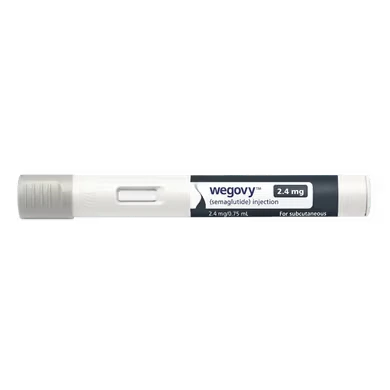

Yes, one GLP-1 is approved to treat fatty liver disease: Wegovy injection, for noncirrhotic MASH with moderate to advanced scarring (fibrosis stages F2 to F3) in adults.1 In the trial behind that approval, liver inflammation cleared without worse scarring in 63% of patients on Wegovy against 34% on placebo after 72 weeks.4 The approval is an accelerated one, granted on biopsy results, and it stays only if a confirmatory trial shows a clinical benefit.1 Tirzepatide, sold as Zepbound and Mounjaro, has strong phase 2 liver results but no liver indication.689
MASH stands for metabolic dysfunction-associated steatohepatitis. It is the label's name for what used to be called NASH: fat in the liver plus inflammation, often with scarring.1 Trial records also use MASLD, short for metabolic dysfunction-associated steatotic liver disease.27 Fibrosis is graded from F0 to F4, where F4 is cirrhosis; the approval covers F2 and F3 only.112
Which drugs are approved for MASH?
| Drug | What it is | MASH on the label? | Key liver trial |
|---|---|---|---|
| Wegovy injection (semaglutide 2.4 mg weekly) | GLP-1 | Yes: noncirrhotic MASH, F2 to F3, adults, accelerated approval1 | Study 11 (ESSENCE), 800 patients at week 7224 |
| Wegovy tablets | GLP-1, oral | No: "have not been established" in MASH3 | Safety in MASH not established3 |
| Ozempic (semaglutide) | GLP-1 | No: type 2 diabetes, heart and kidney uses10 | A 2021 phase 2 tested daily semaglutide injections5 |
| Zepbound and Mounjaro (tirzepatide) | GIP and GLP-1 | No: weight and sleep apnea (Zepbound); diabetes and heart risk (Mounjaro)89 | SYNERGY-NASH, phase 2, 190 people6 |
| Rezdiffra (resmetirom) | Thyroid hormone receptor-beta agonist, not a GLP-1 | Yes: same F2 to F3 MASH population, accelerated approval11 | MAESTRO-NASH, 966 patients12 |
The pattern is the same as with heart protection: an indication belongs to a brand and the population it was tested in. Ozempic and Wegovy contain the same molecule, yet only Wegovy injection lists MASH, and the Wegovy pill does not.1310
What Wegovy did to the liver in its trial
The label's trial, Study 11, is the ESSENCE trial. It enrolled adults whose liver biopsy showed MASH with fibrosis stage 2 or 3, and it runs 240 weeks; the approval rests on a planned look at the first 800 patients at week 72.24 Patients got Wegovy or placebo on top of standard care for their other metabolic conditions and lifestyle counseling.2 Novo Nordisk, which makes Wegovy, funded it.4
- Inflammation cleared, scarring no worse: 62.9% on semaglutide vs 34.3% on placebo.4
- Scarring improved by at least one stage, inflammation no worse: 36.8% vs 22.4%.4
- Both at once: 32.7% vs 16.1%.4
- Body weight: down 10.5% on semaglutide vs 2.0% on placebo.4
- Side effects: gastrointestinal events were more common on semaglutide, and the label says the common reactions matched Wegovy's other uses.34
Read the numbers for what they are. These are biopsy results at 72 weeks, not fewer cases of cirrhosis, liver failure or transplant; the trial continues to 240 weeks to measure those, which is why the FDA calls this an accelerated approval.12 About one in three placebo patients also improved, so the fair comparison is the gap: roughly 29 more people in 100 saw inflammation clear on Wegovy.4
An earlier phase 2 trial is worth knowing because it shows the scarring result is the harder one. Daily semaglutide 0.4 mg cleared NASH in 59% vs 17% on placebo, but fibrosis improved in 43% vs 33%, a gap that was not statistically significant (P = 0.48).5 ESSENCE, at the weekly 2.4 mg dose, showed a gain on both.4
The dose on the label
We do not give dosing advice; the label says this: "The recommended maintenance dosage of WEGOVY injection for the treatment of noncirrhotic MASH with moderate to advanced liver fibrosis in adults is 2.4 mg injected subcutaneously once weekly."3 Your prescriber sets the climb to it. Our Wegovy dosing chart lays out the steps the label lists.
Tirzepatide and fatty liver: strong signal, no approval
Lilly's SYNERGY-NASH trial gave tirzepatide 5, 10 or 15 mg weekly, or placebo, to 190 people with biopsy-confirmed MASH and F2 or F3 fibrosis for 52 weeks.6 MASH cleared without worse fibrosis in 10% on placebo, 44% on 5 mg, 56% on 10 mg and 62% on 15 mg. Fibrosis improved by a stage in 30% on placebo against 51% to 55% across the tirzepatide doses.6
Those percentages look as good as Wegovy's or better, but the trials are not a fair head-to-head: SYNERGY-NASH was a phase 2 dose-finding study with 157 evaluable biopsies, run for 52 weeks rather than 72, and its authors write that "Larger and longer trials are needed."6 That larger trial is SYNERGY-Outcomes: about 4,500 adults with high-risk MASLD, tirzepatide or retatrutide against placebo, measuring hard liver outcomes, still recruiting, with primary completion listed for August 2030.7 Until then neither Zepbound nor Mounjaro lists the liver among its uses.89 For how the two molecules compare on weight, see tirzepatide vs semaglutide.
Rezdiffra, the MASH drug that is not a GLP-1
Rezdiffra (resmetirom) is a daily tablet from Madrigal Pharmaceuticals with the same indication wording as Wegovy: noncirrhotic MASH with F2 to F3 fibrosis, under accelerated approval.11 In MAESTRO-NASH, MASH resolved in 25.9% to 29.9% on the two doses vs 9.7% on placebo, and fibrosis improved in 24.2% to 25.9% vs 14.2%.12 It is a liver-directed thyroid hormone receptor-beta agonist rather than a GLP-1, and its label lists MASH alone, not weight loss.1112 Whether one, the other or both fits is a question for a liver specialist; we only list GLP-1 programs.
Compounded semaglutide and tirzepatide
None of the liver trials above used a compounded product. ESSENCE and the label's Study 11 tested Wegovy; SYNERGY-NASH tested Lilly's tirzepatide.26 A compounded vial may hold the same molecule, but it was not the thing biopsied, and the MASH indication is Wegovy injection's alone.1 If the liver is the reason you want a GLP-1, raise it with the prescriber before you choose a cheaper route. How compounding works is in 503A vs 503B pharmacies.
Will insurance or Medicare pay for a GLP-1 for fatty liver?
MASH is an FDA-approved use of Wegovy injection, separate from weight loss, and that changes the Medicare question.1 KFF notes that Medicare cannot cover drugs "used specifically for weight loss," while Part D plans can cover a GLP-1 "used for a medically accepted FDA-approved indication other than obesity."14 The Medicare GLP-1 Bridge, a $50 monthly copayment program, does not take people with fatty liver disease, and Medicare.gov says why in the same line: "but your Part D plan might cover your GLP-1s."13 So for a Medicare patient with diagnosed MASH, the route is the Part D plan's formulary and prior authorization, not the Bridge. Our Medicare guide covers Part D, and getting a GLP-1 covered covers commercial plans, where the MASH diagnosis and fibrosis stage belong on the request.
What it costs if you pay yourself
The cheapest branded Wegovy pen on our board today is $208 a month. Novo's own self-pay prices by dose are in the ladder below. Compounded semaglutide starts at $69 a month, with the caveat above: it is not the product the liver trial tested.
For the brand side in full, see what Wegovy costs and the Wegovy savings offer. To check whether you qualify for each Wegovy use, read who qualifies for Wegovy and Zepbound.